


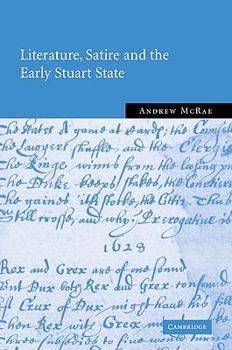
Literature, Satire and the Early Stuart State
No Customer Reviews

Select Format
Select Condition 
Book Overview
Andrew McRae examines the relation between literature and politics at a pivotal moment in English history. He argues that the most influential and incisive political satire in this period may be found in manuscript libels, scurrilous pamphlets and a range of other material written and circulated under the threat of censorship. These are the unauthorised texts of early Stuart England. From his analysis of these texts, McRae argues that satire, as the pre-eminent literary mode of discrimination and stigmatisation, helped people make sense of the confusing political conditions of the early Stuart era. It did so partly through personal attacks and partly also through sophisticated interventions into ongoing political and ideological debates. In such forms satire provided resources through which contemporary writers could define new models of political identity and construct new discourses of dissent. This book wil be of interest to political and literary historians alike.
Format:Paperback
Language:English
ISBN:0521100429
ISBN13:9780521100427
Release Date:January 2009
Publisher:Cambridge University Press
Length:268 Pages
Weight:0.87 lbs.
Dimensions:0.6" x 6.0" x 9.0"
Customer Reviews
0 rating
Copyright © 2026 Thriftbooks.com Terms of Use
| Privacy Policy | Do Not
Sell/Share My Personal Information | Cookie Policy | Cookie Preferences | Accessibility Statement
ThriftBooks® and the ThriftBooks® logo are registered trademarks of Thrift Books Global, LLC
ThriftBooks® and the ThriftBooks® logo are registered trademarks of Thrift Books Global, LLC
