


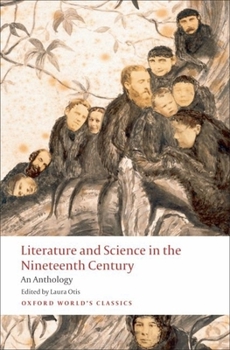
Literature and Science in the Nineteenth Century: An Anthology

Select Format
Select Condition 
Book Overview
Although we are used to thinking of science and the humanities as separate disciplines, in the nineteenth century this division was not recognized. As the scientist John Tyndall pointed out, not only were science and literature both striving to better "man's estate", they shared a common language and cultural heritage. The quest for "origins", the nature of the relationship between society and the individual, and what it meant to be human were subjects that occupied both the writing of scientists and novelists. This anthology brings together a generous selection of scientific and literary material to explore the exchanges and interactions between them. Fed by a common imagination, scientists and creative writers alike used stories, imagery, style, and structure to convey their meaning, and to produce works of enduring power. It includes writing by Charles Babbage, Charles Darwin, Sir Humphry Davy, Charles Dickens, George Eliot, Michael Faraday, Thomas Malthus, Louis Pasteur, Edgar Allan Poe, Mary Shelley, Mark Twain and many others. Also included are introductions and notes to guide the reader. About the Series: For over 100 years Oxford World's Classics has made available the broadest spectrum of literature from around the globe. Each affordable volume reflects Oxford's commitment to scholarship, providing the most accurate text plus a wealth of other valuable features, including expert introductions by leading authorities, voluminous notes to clarify the text, up-to-date bibliographies for further study, and much more.
Format:Paperback
Language:English
ISBN:019955465X
ISBN13:9780199554652
Release Date:August 2009
Publisher:Oxford University Press
Length:624 Pages
Weight:1.04 lbs.
Dimensions:1.5" x 5.0" x 7.7"
Related Subjects
Classics Criticism & Theory Education & Reference English Literature History & Criticism History & Philosophy Literary Literary Criticism Literary Criticism & Collections Literature Literature & Fiction Modern (16th-21st Centuries) Movements & Periods Science Science & Math Science & Scientists Science & Technology TextbooksCustomer Reviews
2 ratings
Wonderful Anthology
Published by Thriftbooks.com User , 15 years ago
I am by no means an expert on nineteenth-century science (and, as you can see from other reviewers, this book doesn't have all that it needs), but this Oxford anthology is fascinating! There are all kinds of examples of scientific writing that would spark the interest of just about anyone and would at least, as it did in my case, give you a great starting point for further research. Of course, the usual topics are covered: Evolution, population, mathematics, etc. However, there are also writings about poverty and women and various other topics. In short, this is an exceptional collection of nineteenth-century scientific writing excerpts. If you enjoy reading nineteenth-century novels (from Dickens to Hardy), then this volume provides wonderful supplementary material.
By Far Best Available on Topic but Incomplete
Published by Thriftbooks.com User , 16 years ago
This anthology is extraordinarily well done. The selections are interwoven, mainly to show the impact of the scientific and medical topics present in the science writings on the literary and poetic works included. It is chosen and arranged with brilliance. It covers the mathematical and physical sciences, the biological and medical science, and the mental and social sciences. One could only wish that the introductions to the general sections were longer and that there were introductions to the subsections, as the author is a McArthur Award winning pioneer in this field full of insights. To criticize such a pioneering and excellent compilation may seem ungrateful, but I think the editor should have added to the title "British Literature and Science" Although there are some French (Pasteur, Lamarck, Bichat, Comte) and some German (Helmholtz, Spurzheim, Engels) and one Italian (Galvani) selection, these are few in contrast to the over ninety English selections. I suspect that the non-English selections were chosen in part for the availability of pre-existing nineteenth century English translations. Also, the foreign language selections are ones that impacted English literature. European writers such as Goethe (who dabbled in at least four sciences, and who included geological and chemical allusions in his poetry and novels) and Zola (who incorporated notions of biological inheritance), as well as the obvious Jules Verne, are not included. There are even, what seem to me, surprising omissions from the English language selections. Charles Kingsley, who wrote on evolutionary topics in "Water Babies" and in his natural theology, and Walt Whitman's "I Hear the Learned Astronomer." Although the selections extensively document the impact of literature on science, they do not document influences in the opposite direction (for instance the impact of Wordsworth's poetry on Darwin, or of Coleridge on Humphry Davy and Faraday as well as on William Rowan Hamilton and Maxwell.) Despite these lacunae this anthology is a path-breaking and monumental achievement and should be of use to all who teach courses on literature and science. Everyone studying the area is in Otis' debt.
Copyright © 2026 Thriftbooks.com
Terms of Use | Privacy Policy | Do Not Sell/Share My Personal Information | Cookie Policy | Cookie Preferences | Accessibility Statement
ThriftBooks ® and the ThriftBooks ® logo are registered trademarks of Thrift Books Global, LLC
ThriftBooks ® and the ThriftBooks ® logo are registered trademarks of Thrift Books Global, LLC
