


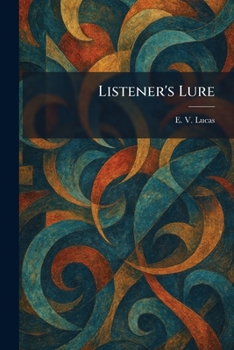
Listener's Lure

"Listener's Lure" is a charming and sophisticated epistolary novel by the prolific English author E.V. Lucas. Written as a series of letters between a diverse group of characters, the narrative unfolds with a light touch, blending humor, social observation, and gentle satire. The story centers on the lives and romantic entanglements of its correspondents, revealing their personalities and motivations through the intimate medium of their personal writings.
As an "oblique narrative," the work relies on the reader to assemble the plot from the various perspectives offered in the correspondence. Lucas, renowned for his essays and wit, demonstrates his mastery of the short form and characterization, creating a vivid portrait of early 20th-century British life. The book explores themes of friendship, domesticity, and the quiet dramas that define human interaction. "Listener's Lure" stands as a testament to the enduring appeal of the epistolary genre, offering a window into a bygone era of thoughtful communication. Its literary value lies in its clever structure and the warmth with which Lucas treats his subjects, making it a delightful choice for readers who appreciate classic literature and character-driven storytelling.
This work has been selected by scholars as being culturally important, and is part of the knowledge base of civilization as we know it. This work was reproduced from the original artifact, and remains as true to the original work as possible. Therefore, you may see the original copyright references, library stamps (as most of these works have been housed in our most important libraries around the world), and other notations in the work.
This work is in the public domain in the United States of America, and possibly other nations. Within the United States, you may freely copy and distribute this work, as no entity (individual or corporate) has a copyright on the body of the work.
As a reproduction of a historical artifact, this work may contain missing or blurred pages, poor pictures, errant marks, etc. Scholars believe, and we concur, that this work is important enough to be preserved, reproduced, and made generally available to the public. We appreciate your support of the preservation process, and thank you for being an important part of keeping this knowledge alive and relevant.
Customer Reviews
ThriftBooks ® and the ThriftBooks ® logo are registered trademarks of Thrift Books Global, LLC
