


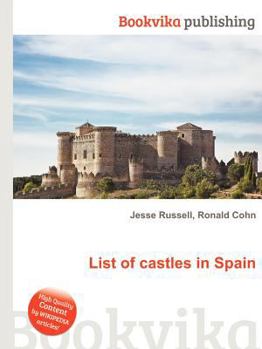
List of Castles in Spain
No Customer Reviews

High Quality Content by WIKIPEDIA articles Castles in Spain were built mainly for defensive purposes. During the Middle Ages, northern Christian kingdoms had to secure their borders with their Muslim southern neighbours, thus forcing both Christian and Muslim kings to grant border fiefs to their liege noblemen so as to keep and maintain defensive fortresses. When the Reconquista advanced, those border castles lost their initial purpose, and, as it happened in the rest of medieval Europe, they were used also as noble residences and fief-keeps. However, due to the forever-at-war context, they kept their military purposes, for enemy invasions were common. In some parts, such as the Basque Country, fiefdoms did not exist as such, and noble families could not afford nor needed huge fortresses, thus appearing many tower houses. On the other hand, in Muslim Spain many castle-palaces were built: the petty taifa kingdoms that arose after the fall of the Caliphate of C rdoba were militarily weak but culturally rich, and every emir or king liked those magnificent palaces of which the Alhambra of Granada is an example. During the late Middle Ages, Christian kingdoms had secured and enriched themselves well enough so as to support a more courtly lifestyle, thus some more residential castles being built: the Alc zar of Segovia was used as the main residence of the kings of Castile, whereas the Castle of Olite, built in a luxurious gothic style was the seat of the Kingdom of Navarre's royal court.
Format:Paperback
Language:English
ISBN:5513286424
ISBN13:9785513286424
Release Date:January 1
Publisher:Book on Demand Ltd.
Length:158 Pages
Weight:0.82 lbs.
Dimensions:0.3" x 8.3" x 11.0"
Customer Reviews
0 rating
Copyright © 2026 Thriftbooks.com Terms of Use
| Privacy Policy | Do Not
Sell/Share My Personal Information | Cookie Policy | Cookie Preferences | Accessibility Statement
ThriftBooks® and the ThriftBooks® logo are registered trademarks of Thrift Books Global, LLC
ThriftBooks® and the ThriftBooks® logo are registered trademarks of Thrift Books Global, LLC
