


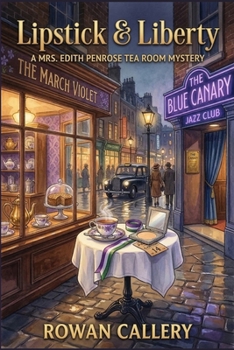
Lipstick & Liberty: A Mrs. Edith Penrose Tea Room Mystery

She had spent twelve years hiding things in plain sight. She recognised the method immediately.
Edith Penrose runs the March Violet Tea Rooms the way she once ran courier routes for the suffrage movement: with complete attention and no wasted motion. She reads a room before she reads a menu - the customer who positions herself with her back to the wall and a clear view of the door is not there for the Victoria sponge. The woman who checks the entrance every thirty seconds is counting something. The compact left on the saucer was not forgotten.
Silver. A little worn at the corners. A functional object chosen, not given. She opened it upstairs, under the lamp, away from Elsie.
The powder had been arranged into three sections.Purple. White. Green. The suffragette colours, set with the precision of someone who knew exactly what they were doing. The system - her system, the one she had helped design and taught to a handful of women and assumed had dispersed along with everything else - was still running. Someone had used it to find her.
The next evening, she put on her good coat and went to the Blue Canary to return the compact to the girl with the good shoes.
The girl was already dead.Daisy had been a dancing girl. She had also, according to everyone who noticed such things, been rather too interested in how the club's books were kept. She had a row with the cornet player the night she died - something about an arrangement sheet with too much of his own handwriting worked into the margins, something she said wasn't his to keep private. The man in the dark suit at the bar had government written in his posture. Nobody was talking about any of it.
In Edith's kitchen pantry, on the highest shelf, six dark green tins had been sitting in the same positions since 1912. The third from the left was slightly less dusty than the others - recently touched, not by Edith.
Inside the tin, wrapped in oilcloth, she found what Daisy had left her: a cloakroom ticket numbered 14, a lipstick wrapper with two words written on the foil in pencil, and a note in Daisy's own hand - the quick, certain writing of someone who had learned efficiency because it was required of her. The note explained what Daisy had found in the archive on Greek Street. It explained why she had to be silenced.Edith had built a quieter life. She had told herself that was a choice. Standing in the kitchen at closing time with the rain ticking against the glass roof and Daisy's note open under the lamp, she understood that the life had simply been waiting - the way a tool waits on a shelf when you are not willing to throw it away.
London, 1926. A system designed to protect women is now being used against them. The smallest object can carry the deadliest truth - and Edith Penrose is the only person left who knows how to read it.
If you love 1920s London, sharp women who read rooms before they read people, and mysteries built on secrets that were never meant to surface - Lipstick & Liberty is your next obsession. Scroll up and grab your copy.
Customer Reviews
ThriftBooks ® and the ThriftBooks ® logo are registered trademarks of Thrift Books Global, LLC
