


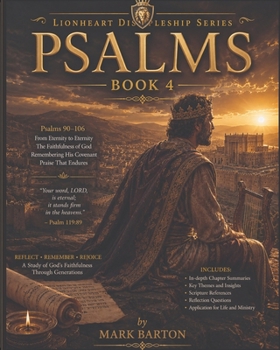
Lionheart Discipleship Expedition Series - Psalms Book 4

Psalms 90-106, traditionally recognized as Book 4 of the Psalter, responds to the crisis that closes Book 3 by redirecting Israel's hope from the apparent failure of the earthly Davidic monarchy to the eternal sovereignty of the Lord, who has always been Israel's true King. The collection begins with Psalm 90, a prayer attributed to Moses, deliberately reaching back before David and the monarchy to proclaim that God has been His people's dwelling place "throughout all generations"; against His everlasting nature, human life appears brief, fragile, and deeply affected by sin, leading to the humble prayer that God would teach His people to number their days and establish the work of their hands. Psalm 91 answers human vulnerability with confidence in God's protection, while Psalm 92 celebrates the goodness of praising the Lord and contrasts the temporary flourishing of the wicked with the enduring fruitfulness of the righteous. Psalms 93-100 then rise into a magnificent proclamation of divine kingship: "The LORD reigns." The Lord is presented as Creator, Judge, Shepherd, and sovereign King whose authority extends over Israel, the nations, the earth, and all creation; therefore, the proper response is reverent worship, joyful praise, holiness, and glad submission to Him. Psalm 101 turns toward the responsibility of righteous leadership, while Psalm 102 voices the anguish of an afflicted person and the suffering of Zion, yet anchors hope in the unchanging God who will arise, restore Zion, and remain forever even though creation itself grows old. Psalms 103-104 broaden the vision from personal redemption to cosmic praise: Psalm 103 celebrates God's forgiveness, compassion, healing, mercy, and fatherly care, while Psalm 104 praises Him as Creator and Sustainer of the ordered world upon which every creature depends. Psalms 105-106 conclude Book 4 by retelling Israel's history from complementary perspectives.
Psalm 105 emphasizes God's covenant faithfulness-from His promises to Abraham through Joseph, the Exodus, wilderness journey, and gift of the land-demonstrating that God remembers and fulfills His word despite seemingly impossible circumstances. Psalm 106, however, honestly recounts Israel's repeated rebellion, unbelief, idolatry, and forgetfulness, confessing that God's people repeatedly failed Him even after witnessing His mighty acts. Yet Israel's sin does not become the final word: God repeatedly hears their cries, remembers His covenant, shows compassion, and preserves His people according to His steadfast love. Thus, the storyline of Psalms 90-106 moves from human mortality and failed earthly security to the triumphant declaration that God Himself reigns, and then to historical proof that His covenant faithfulness survives the failures of His people. Book 4 therefore teaches believers that when human leaders fail, circumstances collapse, life proves uncertain, or God's promises seem distant, their ultimate security has never rested in earthly kingdoms but in the eternal Lord. He was faithful before Israel had a king, remained King through Israel's darkest seasons, and will reign forever. Psalms 90-106 consequently call God's people to humility, repentance, remembrance, obedience, worship, and confident hope, assuring them that the sovereign God who judges sin is also compassionate and merciful, faithful to His covenant, steadfast in love, and worthy of praise from generation to generation.
Customer Reviews
ThriftBooks ® and the ThriftBooks ® logo are registered trademarks of Thrift Books Global, LLC
