


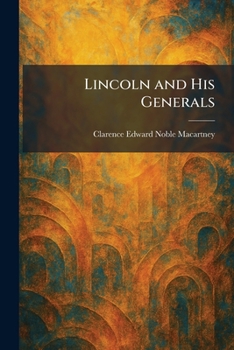
Lincoln and His Generals

Select Format
Select Condition 
Book Overview
"Lincoln and His Generals" offers a compelling and detailed examination of one of the most critical aspects of the American Civil War: the relationship between President Abraham Lincoln and the men he appointed to lead the Union armies. Written by noted historian Clarence Edward Noble Macartney, this work delves into the strategic, political, and personal conflicts that shaped the course of the war. Through a series of biographical sketches, the author explores Lincoln's evolution as Commander-in-Chief, highlighting his patience, frustration, and eventual mastery of military oversight.
The narrative provides deep insights into the character and performance of key figures such as George B. McClellan, Ambrose Burnside, Joseph Hooker, and George Meade, culminating in the successful partnership Lincoln eventually forged with Ulysses S. Grant. Macartney skillfully analyzes how Lincoln balanced the demands of a fractured cabinet, a wary public, and the varying temperaments of his generals. This study remains an essential resource for those interested in the intricacies of leadership, the management of war, and the indomitable spirit of a president determined to save the Union. It stands as a significant contribution to Civil War literature, providing a nuanced perspective on the burdens of command during the nation's greatest crisis.
This work has been selected by scholars as being culturally important, and is part of the knowledge base of civilization as we know it. This work was reproduced from the original artifact, and remains as true to the original work as possible. Therefore, you may see the original copyright references, library stamps (as most of these works have been housed in our most important libraries around the world), and other notations in the work.
This work is in the public domain in the United States of America, and possibly other nations. Within the United States, you may freely copy and distribute this work, as no entity (individual or corporate) has a copyright on the body of the work.
As a reproduction of a historical artifact, this work may contain missing or blurred pages, poor pictures, errant marks, etc. Scholars believe, and we concur, that this work is important enough to be preserved, reproduced, and made generally available to the public. We appreciate your support of the preservation process, and thank you for being an important part of keeping this knowledge alive and relevant.
Customer Reviews
ThriftBooks ® and the ThriftBooks ® logo are registered trademarks of Thrift Books Global, LLC
