


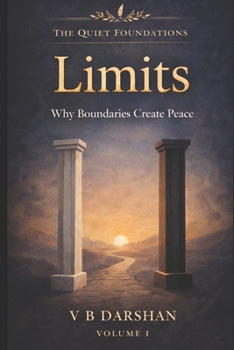
Limits: Why Boundaries Create Peace

Limits: Why Boundaries Create Peace
Volume I
We live in an age that equates freedom with the removal of limits. Yet anxiety, fragmentation, exhaustion, and conflict continue to rise. This book begins with a simple but unsettling claim: life does not collapse because of boundaries-it collapses without them.
Limits: Why Boundaries Create Peace is not a book of rules or moral instruction. It is an inquiry into structure-why human beings, relationships, and societies require edges in order to remain stable, dignified, and free. Across 160 tightly reasoned chapters, this volume examines limits not as constraints imposed from outside, but as frameworks that make attention possible, identity coherent, and coexistence sustainable.
Volume I moves deliberately from the inner world to the collective:
It begins with attention, choice, and psychological overload-why limitless options weaken clarity rather than expand it.
It then examines moral boundaries, showing how ethics lose weight when everything becomes permissible.
From there, it explores identity, commitment, and self-definition, arguing that a self without limits cannot endure.
The later sections turn outward-to law, authority, relationships, family, education, and community-revealing how social order depends not on control, but on shared restraint.
The volume concludes with peaceful coexistence, not as an idealistic dream, but as a fragile achievement sustained by boundaries honored even when they are inconvenient.
This is a quiet, serious book written for readers who sense that something essential has been lost in a culture of endless flexibility. It does not argue for rigidity, nostalgia, or authoritarian order. It argues for proportion, containment, and responsibility-conditions without which freedom becomes unsustainable.
Limits is for readers interested in psychology, philosophy, ethics, social stability, and the deeper architecture of human life. It is especially suited for those who feel overwhelmed by constant choice, exhausted by negotiation, or unsettled by the erosion of shared norms-and who are looking not for slogans, but for clarity.
Volume I establishes the foundations: why limits matter, where they belong, and what they quietly make possible.
Volume II continues the work by examining what happens when these limits collapse-and what it takes to rebuild meaning, responsibility, and direction afterward.
This book does not promise easy answers.
It offers something rarer: structure where chaos has become normal, and peace where limits are finally understood not as enemies-but as the conditions of a life that can hold together.
Related Subjects
PhilosophyCustomer Reviews
ThriftBooks® and the ThriftBooks® logo are registered trademarks of Thrift Books Global, LLC
