


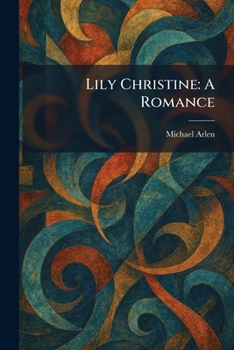
Lily Christine: A Romance

Select Format
Select Condition 
Book Overview
"Lily Christine: A Romance" is a compelling exploration of social mores, loyalty, and the complexities of human relationships within the glittering yet unforgiving landscape of 1920s London high society. Written by the celebrated Michael Arlen, this novel follows the life of the eponymous Lily Christine Summerest, a woman of profound integrity and charm who finds herself entangled in a web of misunderstandings and social scandal.
The narrative delves into the fragile nature of reputation and the heavy toll of societal expectations. As Lily Christine navigates the challenges of a failing marriage and the unintended consequences of her own kindness, the story reveals a poignant critique of the era's double standards. Arlen's signature wit and sophisticated prose capture the essence of the Jazz Age, blending romantic idealism with a tragic awareness of the era's underlying disillusionment.
A masterwork of psychological depth, "Lily Christine: A Romance" offers a vivid portrait of a woman striving for authenticity in a world defined by artifice. This work remains a significant contribution to early 20th-century literature, providing readers with a sophisticated look at the tensions between private emotion and public image.
This work has been selected by scholars as being culturally important, and is part of the knowledge base of civilization as we know it. This work was reproduced from the original artifact, and remains as true to the original work as possible. Therefore, you may see the original copyright references, library stamps (as most of these works have been housed in our most important libraries around the world), and other notations in the work.
This work is in the public domain in the United States of America, and possibly other nations. Within the United States, you may freely copy and distribute this work, as no entity (individual or corporate) has a copyright on the body of the work.
As a reproduction of a historical artifact, this work may contain missing or blurred pages, poor pictures, errant marks, etc. Scholars believe, and we concur, that this work is important enough to be preserved, reproduced, and made generally available to the public. We appreciate your support of the preservation process, and thank you for being an important part of keeping this knowledge alive and relevant.
Customer Reviews
ThriftBooks ® and the ThriftBooks ® logo are registered trademarks of Thrift Books Global, LLC
