


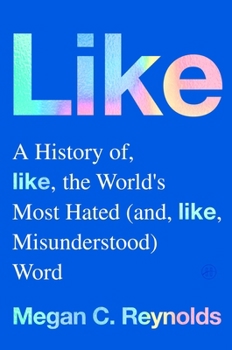
Like: A History of the World's Most Hated (and Misunderstood) Word

Select Format
Select Condition 
Book Overview
A comprehensive and thought-provoking work of cultural criticism investigating one of the most polarizing words in the English language.
Few words in the English language are as misunderstood as "like." Indeed, excessive use of this word is a surefire way to make those who pride themselves on propriety, both grammatical and otherwise, feel compelled to issue correctives.
But what the detractors of this word fail to understand is its true linguistic function and versatility--as an exclamation, a filler of space, a means of subtle emphasis, and more. "Like" may have started out as slang, but it is now an intrinsic component of fun, serious, and altogether nurturing communication. And like any colloquialism, the word endears the speaker to its audience; a conversation full of likes feels more casual, despite its content.
In this book, culture writer and editor for Dwell magazine Megan C. Reynolds takes us on a pop culture journey through the unique etymology and usage of this oft-reviled word, highlighting how the policing of women's speech is often used to undermine people who are traditionally seen as having less status in society--women, younger people, people from specific subcultures--and how, if thought about differently, it might open up a new way of communication and validation. Written in a breezy yet informative and engaging style, this is a must-read for anyone who considers themselves a grammarian, a lover of language, and an advocate for the marginalized in discussions of cultural capital, power, and progress.
This deep dive into sociolinguistics and pop culture reveals:
History of the English Language: Discover how "like" has been a part of English for centuries, long before the Valley Girls of the Sherman Oaks Galleria made it famous.Sociolinguistics in Action: Explore the fascinating reasons why women and younger people are often linguistic innovators--and why their speech is so often criticized.Word Origins and Etymology: Unpack the complex versatility of "like" as a discourse marker, a quotative, a hedge, and a tool for building connection.Feminist Theory: A powerful argument for how, far from being a sign of insecurity, the word can be a tool for validation and wielding cultural capital.Customer Reviews
ThriftBooks® and the ThriftBooks® logo are registered trademarks of Thrift Books Global, LLC
