


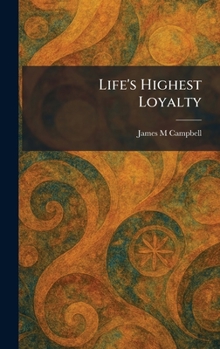
Life's Highest Loyalty

"Life's Highest Loyalty" is a profound exploration of the spiritual and moral obligations that define a life of faith. Written by James M. Campbell, this work delves into the concept of loyalty not as a mere abstract ideal, but as the central driving force of the Christian experience. The author examines the various claims made upon the human soul, arguing that true fulfillment and character are found only when one's supreme allegiance is directed toward the divine.
Through a series of insightful reflections, Campbell addresses the practical application of devotion in daily life. He explores themes of sacrifice, steadfastness, and the transformative power of a dedicated heart. The text serves as both a theological inquiry and a guide for personal spiritual growth, challenging readers to consider where their ultimate loyalties lie and how those commitments shape their actions and worldview.
This volume remains a significant contribution to early twentieth-century religious literature, offering timeless wisdom on the intersection of ethics and spirituality. "Life's Highest Loyalty" is an essential read for those seeking a deeper understanding of the Christian call to faithful service and the enduring importance of spiritual integrity.
This work has been selected by scholars as being culturally important, and is part of the knowledge base of civilization as we know it. This work was reproduced from the original artifact, and remains as true to the original work as possible. Therefore, you may see the original copyright references, library stamps (as most of these works have been housed in our most important libraries around the world), and other notations in the work.
This work is in the public domain in the United States of America, and possibly other nations. Within the United States, you may freely copy and distribute this work, as no entity (individual or corporate) has a copyright on the body of the work.
As a reproduction of a historical artifact, this work may contain missing or blurred pages, poor pictures, errant marks, etc. Scholars believe, and we concur, that this work is important enough to be preserved, reproduced, and made generally available to the public. We appreciate your support of the preservation process, and thank you for being an important part of keeping this knowledge alive and relevant.
Customer Reviews
ThriftBooks ® and the ThriftBooks ® logo are registered trademarks of Thrift Books Global, LLC
