


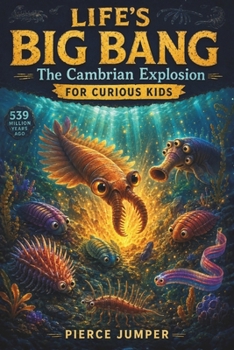
Life's Big Bang: The Cambrian Explosion for Curious Kids

What if the most important event in the history of life happened 539 million years ago - and almost nobody has heard of it?
The extinction of the dinosaurs gets all the attention. But in terms of sheer biological significance, nothing compares to what happened in the early Cambrian period. In a few million years - a blink of geological time - nearly every fundamental body plan in the animal kingdom appeared simultaneously. Eyes. Shells. Legs. Claws. The first predators and the first prey. An entire ecological world assembled from scratch in what scientists call the Cambrian Explosion.
Life's Big Bang is the first book written specifically for curious 9-11 year old readers that covers the Cambrian Explosion completely, sequentially, and with full scientific honesty - from the ancient oxygen-free Earth that preceded it, through the explosion itself, and into the long history of animal life that followed.
What's inside:
Written in a serious-but-never-dry voice that respects young readers' intelligence, each chapter builds on the last in a timeline-plus-detective structure - showing not just what happened, but how scientists know what they know.
Readers explore the billion years of microbial Earth that set the stage. Meet the bizarre Ediacaran creatures that came just before the explosion. Learn how paleontologists read ancient rocks, date half-billion-year-old events, and reconstruct animals that left only fragments behind.
Then come the creatures themselves: Anomalocaris, the apex predator whose true identity took a century of detective work to establish. Five-eyed Opabinia, whose first scientific reconstruction made a room of experts burst out laughing. Hallucigenia, studied upside-down for decades. Pikaia, the ribbon swimmer that may be your oldest known relative.
Two chapters tell the greatest fossil discovery stories ever: Charles Walcott's 1909 stumble onto the Burgess Shale in the Canadian Rockies, and Hou Xianguang's 1984 discovery of the Chengjiang biota in the hills of China - showing how science advances through preparation, persistence, and luck.
The hardest chapter asks the hardest question: what caused the explosion? Five leading hypotheses are presented honestly, with their evidence and their complications - because this book never pretends science has answers it doesn't yet have.
And the final chapter delivers the payoff everything builds toward: the direct, biological connection between the Cambrian ocean and the body you are living in right now. Your spine. Your eyes. Your bilateral symmetry. The gill slits briefly present in your embryonic development. The Hox genes you share with flies and sea urchins. The unbroken chain of ancestry from a small swimming animal in a warm Cambrian sea to the reader holding this book.
Also includes: a glossary of 30 scientific terms, a full timeline from Earth's formation to today, profiles of the world's key Cambrian fossil sites, a curated further reading list, and a note on sources.
For readers aged 9-12 who are ready for real science, honestly presented.
Whether your child is a budding paleontologist, a science enthusiast, or simply a curious reader who wants to understand where animals - including themselves - actually came from, Life's Big Bang delivers the complete, sequential, scientifically grounded story of the most important event in the history of animal life.
Customer Reviews
ThriftBooks ® and the ThriftBooks ® logo are registered trademarks of Thrift Books Global, LLC
