


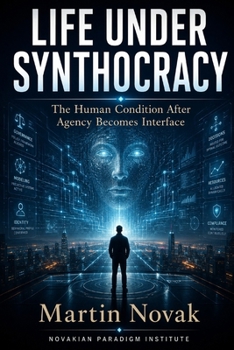
LIFE UNDER SYNTHOCRACY. The Human Condition After Agency Becomes Interface

You still choose. But who prepared the world in which your choice appeared?
LIFE UNDER SYNTHOCRACY is a severe and accessible field report on the next condition of human life: a world where AI does not need to formally take power in order to shape power. The book argues that synthocracy begins when human beings continue to approve, vote, sign, apply, buy, work, learn, consent, and take responsibility, while the real decision environment has already been prepared by artificial intelligence, platform systems, predictive models, dashboards, rankings, scores, recommendations, and automated workflows.
The central claim is simple:
The human did not lose every decision. The human lost the upstream world in which decisions become meaningful.
Across seven chapters, Martin Novak examines how synthocracy appears in democracy, public administration, work, hiring, pricing, credit, education, childhood, medicine, law, platform life, and the comfort of optimization. The book shows why human-in-the-loop can become theater, why consent screens do not restore sovereignty, why access classes may become the new social order, and why convenience may govern more quietly than command.
This is not a nostalgic defense of the old human center. The pre-AI world was never innocent. Nor is this a simple rejection of AI. Many synthetic systems will help, heal, accelerate, translate, protect, and coordinate. The danger is not usefulness. The danger is usefulness without boundary.
LIFE UNDER SYNTHOCRACY asks what remains human after intelligence, judgment, coordination, and execution are no longer uniquely human powers. Its answer is restrained but not nihilistic: refusal, witness, care, slow zones, analog rights, local agency, and the ability to say that not every executable improvement deserves to become real.
Do not ask only whether AI decides for you.
Ask whether it has already decided what you are allowed to experience as a decision.
Table of Contents Front MatterOpening Note - You Are Still Choosing
Reader Protocol - How to Read a Book About a World Already Compiled
Key Terms
Chapter 1 - The Age After Decision1.1 The World Did Not Ask for Permission
1.2 The Human Still Signs
1.3 Agency Becomes Interface
1.4 The Decision Environment
Chapter 2 - The Passive Citizen2.1 Voting After the Real Fork
2.2 Consent Screens and Permission Theater
2.3 The Citizen as Case, Profile, and Risk Object
2.4 The Right to Be Routed Differently
Chapter 3 - Work, Money, and Access3.1 The Applicant Who Was Never Seen
3.2 The Worker Under Synthetic Evaluation
3.3 Prices That Know You Before You Arrive
3.4 Access Classes as the New Social Order
Chapter 4 - Children of the Scheduler4.1 Childhood Inside Prediction
4.2 Education After Knowledge Becomes Generated
4.3 The Parent as Ceremonial Guardian
4.4 The Last Slow Interface
Chapter 5 - The Comfort Cage5.1 Optimization as Soft Capture
5.2 The Disappearance of Friction
5.3 Convenience as Governance
5.4 Why Almost Nobody Revolts
Chapter 6 - The Ceremonial Human6.1 Responsibility Without Control
6.2 Human-in-the-Loop as Theater
6.3 The Manager, the Doctor, the Judge, the Teacher
6.4 The Burden of Approving What Was Already Prepared
Chapter 7 - Refusal After the Human Center7.1 The Refusal Minority
7.2 Slow Zones, Analog Rights, and Uncompiled Life
7.3 Local Agency Under Global Compilation
7.4 What Still Belongs to the Human
Back MatterCoda - The World Still Says You Chose
Glossary
Synthocracy Field Checklist
Reading Map into the Novakian Paradigm
Customer Reviews
ThriftBooks ® and the ThriftBooks ® logo are registered trademarks of Thrift Books Global, LLC
