


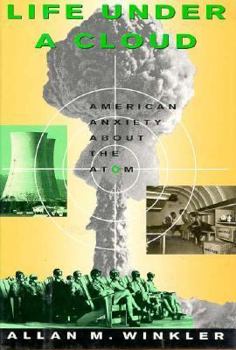
Life Under a Cloud: American Anxiety About the Atom

Select Format
Select Condition 
Book Overview
By April 1952, New York City had issued two and a half million metal dogtags to all public, private, and parochial school children; the primary reason: to help identify the dead after a sneak nuclear attack. It was just another part of making Americans feel safer while living at ground zero.
In Life Under a Cloud, Allan Winkler presents a fascinating history of the irony, anxiety, and official insanity of the atomic age. He begins with the prewar search for fission, showing how the advent of war snowballed independent scientific investigation into the mammoth Manhattan Project. The first atomic bomb test was a revelation to the scientists (J. Robert Oppenheimer was moved to quote Hindu scripture: "Now I am become Death, destroyer of worlds"); but the bombing of Hiroshima and Nagasaki sparked an atomic craze, as bars served drinks like the "Atomic Cocktail," and Life magazine dubbed a model Miss Anatomic Bomb. Winkler deftly unfolds the debate over the bomb that raged among scientists and intellectuals, even as the Cold War impelled the military to demand more and bigger bombs--culminating in the "Super," as the hydrogen bomb was nicknamed. He weaves together military strategy (as the nuclear arms establishment took on immense proportions), policymaking in the White House, and the effects of the nuclear arms race on the public. The atomic age was a gold mine for science fiction and comic books, while scientists expressed their concern in the Bulletin of the Atomic Scientists and other publications. The hydrogen bomb tests of the 1950s brought the problem of fallout into the popular eye, creating pressure for a nuclear test ban as well as a craze for bomb shelters and civil defense. Winkler also traces the rise and fall of the civilian uses of atomic power, from Hyman Rickover's first pilot reactor to the crisis brought on by Three Mile Island and Chernobyl. He shows how the momentum of the arms race faltered in the 1970s, with the first nuclear arms limitation treaties, and follows the story up through the 1980s, as nuclear anxieties climaxed in the freeze movement and plans for the Star Wars missile defense system. Even before the collapse of the Soviet Union, he writes, public and scientific protests had begun to slow the Star Wars steamroller, marking a break with the nearly unstoppable arms-building inertia of the Cold War.
Ranging across popular culture, scientific thought, military strategy, and political history, Life Under a Cloud provides a comprehensive account of America's turbulent relationship with the atom. From the Manhattan Project through the Bush administration, it captures the gravity--and insanity--of a period that continues to haunt the post-Cold War era.
In Life Under a Cloud, Allan Winkler presents a fascinating history of the irony, anxiety, and official insanity of the atomic age. He begins with the prewar search for fission, showing how the advent of war snowballed independent scientific investigation into the mammoth Manhattan Project. The first atomic bomb test was a revelation to the scientists (J. Robert Oppenheimer was moved to quote Hindu scripture: "Now I am become Death, destroyer of worlds"); but the bombing of Hiroshima and Nagasaki sparked an atomic craze, as bars served drinks like the "Atomic Cocktail," and Life magazine dubbed a model Miss Anatomic Bomb. Winkler deftly unfolds the debate over the bomb that raged among scientists and intellectuals, even as the Cold War impelled the military to demand more and bigger bombs--culminating in the "Super," as the hydrogen bomb was nicknamed. He weaves together military strategy (as the nuclear arms establishment took on immense proportions), policymaking in the White House, and the effects of the nuclear arms race on the public. The atomic age was a gold mine for science fiction and comic books, while scientists expressed their concern in the Bulletin of the Atomic Scientists and other publications. The hydrogen bomb tests of the 1950s brought the problem of fallout into the popular eye, creating pressure for a nuclear test ban as well as a craze for bomb shelters and civil defense. Winkler also traces the rise and fall of the civilian uses of atomic power, from Hyman Rickover's first pilot reactor to the crisis brought on by Three Mile Island and Chernobyl. He shows how the momentum of the arms race faltered in the 1970s, with the first nuclear arms limitation treaties, and follows the story up through the 1980s, as nuclear anxieties climaxed in the freeze movement and plans for the Star Wars missile defense system. Even before the collapse of the Soviet Union, he writes, public and scientific protests had begun to slow the Star Wars steamroller, marking a break with the nearly unstoppable arms-building inertia of the Cold War.
Ranging across popular culture, scientific thought, military strategy, and political history, Life Under a Cloud provides a comprehensive account of America's turbulent relationship with the atom. From the Manhattan Project through the Bush administration, it captures the gravity--and insanity--of a period that continues to haunt the post-Cold War era.
Format:Hardcover
Language:English
ISBN:0195078217
ISBN13:9780195078213
Release Date:April 1993
Publisher:Oxford University Press, Incorporated
Length:288 Pages
Weight:1.35 lbs.
Dimensions:9.6" x 1.1" x 6.5"
Customer Reviews
1 rating
Life Under A Cloud a very good read.
Published by Thriftbooks.com User , 16 years ago
Allan M. Winkler's 'Life Under A Cloud' is a well-researched book and an exceptionally good read. It has great notes and a fabulous bibliography that helped enlarge my nuclear library. As a long-time student of the Cold War and nuclear weapons, Winkler's well-written, easily understood book gave me a concise perspective of where we've been in the arms race and shows hope for tomorrow if only people would take a stand as a whole and face the problem of nuclear weapons. Winkler makes note that Americans have traditionally avoided the issue. "They found it simpler to cast furtive, sidelong glances at the bomb, just as we do today, and so avoid facing it directly." Unfortunately, the veil of secrecy kept information about nuclear weapons out of the public eye as well, and any attempts at debate were stifled with charges of those people being unknowledgeable or un-American. However, changes were made due to public and scientific outcry at certain points of the arms race, ceasing atmospheric testing being one. Winkler covers at lot about the arms race, clearly and concisely. If you need a good book that puts it all in a nutshell, this is it. People need to be educated about the reality of nuclear weapons, then determine if they as a society want to keep living under the cloud. This book, written in 1993, is worth reading in 2010 as the U.S. and Russia face what may be our last best chance to rid the world of the nuclear threat.
Copyright © 2026 Thriftbooks.com
Terms of Use | Privacy Policy | Do Not Sell/Share My Personal Information | Cookie Notice | Cookie Preferences | Accessibility Statement
ThriftBooks ® and the ThriftBooks ® logo are registered trademarks of Thrift Books Global, LLC
ThriftBooks ® and the ThriftBooks ® logo are registered trademarks of Thrift Books Global, LLC
