


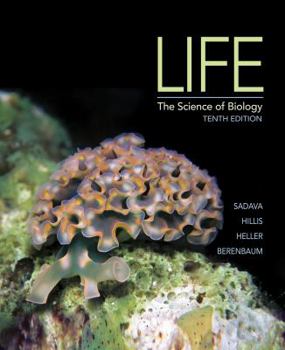
Life: The Science of Biology

Select Format
Select Condition 
Book Overview
PLEASE NOTE: This title is distributed and sold by W. H. Freeman/Macmillan Learning. With roots 10 editions deep, Life: The Science of Biology blends carefully reviewed content and an emphasis on... This description may be from another edition of this product.
Format:Hardcover
Language:English
ISBN:1429298642
ISBN13:9781429298643
Release Date:December 2012
Publisher:W. H. Freeman
Length:1267 Pages
Weight:7.46 lbs.
Dimensions:11.1" x 1.9" x 9.3"
Customer Reviews
5 ratings
Wonderful textbook!
Published by Thriftbooks.com User , 19 years ago
I graduated from college in the early 70's with a B.S. major in Physics. Having retired from the business world, I recently discovered the absolutely wonderous advances in what I believed to be the "non-physical" sciences. Hooray for E.O.Wilson's concept of concilience! I'm studying Biology using "Life" and its associated website. What amazing fun! I love this book and it is the best textbook I've ever studied. This book is not a good "read" - it's a great book to study!
I'm in Biology heaven
Published by Thriftbooks.com User , 21 years ago
Ah, the holy grail of textbooks: To find a textbook that is completely clear, explains all aspects of the subject, lets you understand rather than just memorize so you can think independently on the subject and actually enjoyable to read. Textbooks like those are incredibly rare and they are worth their weight in gold once you find them. Looks like we found one for biology.
Thorough, clearly written text for college-level biology.
Published by Thriftbooks.com User , 21 years ago
First, just to let you know what perspective I am reviewing this from, I am a college student, and this text was used in my 200-level introductory biology course. Since I am a student, and not a professor or expert of any sort, I am evaluating the book based on how helpful it was to me in learning the material. For input from biology professors, you'll have to take a look at some of the other reviews here. "Life: The Science of Biology" has definitely been one of the better biology textbooks I've used. The text is well written, with clear explanations and plenty of real-life examples to help you tie small details into the bigger picture. But beware: The information here is incredibly in-depth, so if you're only looking for a basic overview of biology, you may actually want a slightly simpler book, otherwise you may get lost in all the details. It was perfect for my 200-level class, and gave me all the information I needed, but I don't think it would be the ideal text for an introductory biology course. One other reviewer here mentioned that she used this text to teach her AP biology students. I took AP biology in high school (and got a 5 on the exam) and can guarantee you that this text contains far, far more than you would ever need to know to get a perfect score. It's definitely a college level text. The book has numerous detailed, well-labeled diagrams that are helpful in understanding different processes. In fact, being a rather visual, hands-on learner, I sometimes found the step-by-step diagrams easier to follow than the text itself. There are also plenty of great photographs and other helpful images. At the end of each chapter there is a bare-bones overview of key points you should know, and a self-quiz to help you evaluate your grasp of the material. At the end of the book there is an extensive glossary with definitions of key terms. Unfortunately, there is one mistake in this book, to be found in chapter 34, "Deuterostomate Animals." On page 674, some text from the previous page is repeated, and this in turn means that part of the section entitled "Primates and the Origin of Humans" is cut off, even ending in mid-sentence. The following page is filled entirely with pictures and diagrams, no text, and then on page 676 where the text starts up again, it skips to the beginning of the next section, entirely leaving out a chunk of information. This is the only place in the book where I found such a problem. There is a website to accompany this text (www.thelifewire.com). I never found it necessary to use the site for my studies, but it may be helpful for some. It contains chapter summaries, animated tutorials, text-related activities, self quizzes, suggestions for further reading, and a glossary of key terms (same as the one found at the back of the book). The book is also supposed to come with a CD-ROM. My school's bookstore was selling the books and CDs separately, and I did not purchase the CD and so cannot evaluate its usefulness. I k
++Excellent textbook studied by students in UCLA
Published by Thriftbooks.com User , 22 years ago
There's a reason why this textbook is used at one of the top public universities in the nation. It is clearly written, lots of pictures that has step-by-step comments, a concise chapter summary and discussion questions. Chapters are relatively short at 16-26 pages each, full of detailed pictures and fairly easy reading for the scientific individual. Compared to Scientific American, it is easier to read. The CD-ROM has flashcards, animated tutorials (videos and sound), games, self-quizzes (small) and large chapter quizzes (multiple choice) with explanations for every answer you got incorrect or correct. The animation videos are very helpful in picturing abstractions such as molecular formation. Study guide has a more in-depth chapter summary notes and more multiple choice questions with explanations to the answers. Many if not all chapters related to current news updates on science, so the book is a very recent infusion of current science developments with past biology. UCLA students have used books from these authors for a few years now in their Life Science 1,2 courses (biology). Excellent text. I had a fun time in the class both because of my outstanding professor Dr. Kubasak and the outstanding textbook!
Best Biology Textbook Publication in a very long time!!!
Published by Thriftbooks.com User , 27 years ago
I have reviewed Campbell, Curtis & Barnes, and other fine textbooks in biology, as a teacher and a scientist, I find Purves, etal; Life , A Science of Biology as the best textbook on the market. His clear explanation of the concepts with bright, colorful pictures have helped my students to understand biological concepts for the AP Bio exam as well as preparing them for college. The questions after each and every chapter plainly incorporate the chapter's lessons as well as inclusion of the continuity of life that is important in all biology teaching. His book had already included the new domain designations and included the reasons as why they were being changed. ( As this was the infamous #3 question on the AP Bio exam.) As a trained molecular biologist, I am finally satisfied in the explanation of the molecular process of life. Again his use of good solid pictures help to re-enforce a difficult concept. I also know that MIT uses this book as well as Harvard, I urge every biology teacher professor to at least have this in their personal library.
Copyright © 2026 Thriftbooks.com
Terms of Use | Privacy Policy | Do Not Sell/Share My Personal Information | Cookie Notice | Cookie Preferences | Accessibility Statement
ThriftBooks ® and the ThriftBooks ® logo are registered trademarks of Thrift Books Global, LLC
ThriftBooks ® and the ThriftBooks ® logo are registered trademarks of Thrift Books Global, LLC
