


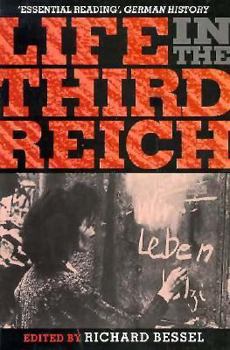
Life in the Third Reich


Select Format
Select Condition 
Book Overview
Few historical subjects are so emotion-laden as the Third Reich, and few have generated such general interest. The extermination of the Jews has, understandably, commanded considerable attention from historians and the general public, but this preoccupation with Nazi anti-Semitism has led people to overlook other aspects of life under the Third Reich.
This collection presents a broad view of life in Nazi Germany, describing the ways ordinary Germans perceived the policies and actions of the Third Reich, as well as how they lived their daily lives. Articles by noted historians provide fascinating insights into the character of the German people, describing such phenomena as the satisfaction German nationalists took in the orderliness of Hitler's takeover; the contradictory reactions of Germany's young people to the Nazi state; the powerful popular image of Hitler, created by the then new techniques of propaganda; and the way Germans today regard their experiences under Hitler. The articles presented here offer new perspectives on some of the most challenging questions of our time, and enrich our understanding of an awful chapter of German history.
This collection presents a broad view of life in Nazi Germany, describing the ways ordinary Germans perceived the policies and actions of the Third Reich, as well as how they lived their daily lives. Articles by noted historians provide fascinating insights into the character of the German people, describing such phenomena as the satisfaction German nationalists took in the orderliness of Hitler's takeover; the contradictory reactions of Germany's young people to the Nazi state; the powerful popular image of Hitler, created by the then new techniques of propaganda; and the way Germans today regard their experiences under Hitler. The articles presented here offer new perspectives on some of the most challenging questions of our time, and enrich our understanding of an awful chapter of German history.
Format:Paperback
Language:English
ISBN:0192851845
ISBN13:9780192851840
Release Date:November 1987
Publisher:Oxford University Press
Length:144 Pages
Weight:0.30 lbs.
Dimensions:7.6" x 0.5" x 5.0"
Customer Reviews
3 ratings
Daily life on the streets....
Published by Thriftbooks.com User , 15 years ago
This book has a series of essays about daily life of the Third Reich, from how politics effected family life to how the children were educated and trained under the ideals of the Nazi party. History seen from street level, not from high above. This is about individuals and families, not about movements and parties. I learned more about the Nazi take over of power, and how it caused changes within the villages, businesses, and governments, in this one book then all of the other books on the Third Reich and the Nazi Party that I have in my collection.
Interesting Collection of Essays
Published by Thriftbooks.com User , 22 years ago
Life in the Third Reich offers eight essays on various aspects of Nazi culture. As Richard Bessel notes in his introduction, the Third Reich is not just the story of good versus evil but is a more complex study characterized by contradictions and paradoxes. Germans who disapproved of the violence of Hitler's SA may also have appreciated the Nazis' efforts to put down crime and restore social order to a nation influx. Germans who feared the Gestapo agents and the nation's drive toward war also welcomed the Anschluss with Austria and the incorporation of the Sudetenland. Bessel's essay is entitled "Political Violence and the Nazi Seizure of Power." Bessel looks at the violence that helped the Nazi party gain power, which was often seen as legitimate when working as an "auxiliary police" force, and the violence against Jews, which was seen as excessive and hindered Nazi support. Still, the old guard allowed Hitler to come the power and Nazi violence at that time had its limits (i.e. there was no terrorist activity). Gerhard Wilke's "Village Life in Nazi Germany" looks at Koerle in north Hesse and how Nazism altered social relationships. A very interesting essay is "Youth in the Third Reich" by Detlev Peukert. Peukert describes how the increasingly coercive and drill-minded nature of the Hitler Jugend led to a youth subculture of gangs like the Edelweiss Pirates and movements like Swing jazz. Ian Kershaw explains the seven bases of the Hitler myth in "Hitler and the Germans." "Social Outcasts in the Third Reich" by Jeremy Noakes includes information on such topics as eugenics and sterilization. Other essays cover the Nazi state, policies against the Jews, and "Good Times, Bad Times: Memories of the Third Reich."This book is an excellent source of topics not often covered in other books. It is well-researched by some of the best historians of Nazi Germany and includes two sections of b & w photos.
Good information
Published by Thriftbooks.com User , 25 years ago
This is a book of collected essays by several authors, including the famous Ian Kershaw, that features some very good information. The book deals with several aspects of life within Nazi Germany including how the Nazis came to power, youth, the "Hitler myth", the policy against the Jews, and the way the Nazi state was run. The differing installments are well-written, and although some parts can be dry this book is a good introduction to what daily life was like within the Reich.
Copyright © 2026 Thriftbooks.com Terms of Use
| Privacy Policy | Do Not
Sell/Share My Personal Information | Cookie Policy | Cookie Preferences | Accessibility Statement
ThriftBooks® and the ThriftBooks® logo are registered trademarks of Thrift Books Global, LLC
ThriftBooks® and the ThriftBooks® logo are registered trademarks of Thrift Books Global, LLC
