


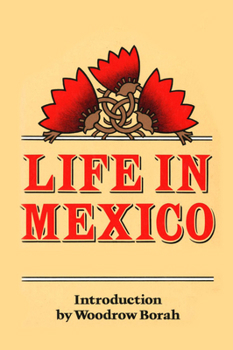
Life in Mexico

Select Format
Select Condition 
Book Overview
Originally published in 1843, Fanny Calderon de la Barca, gives her spirited account of living in Mexico-from her travels with her husband through Mexico as the Spanish diplomat to the daily struggles with finding good help-Fanny gives the reader an enlivened picture of the life and times of a country still struggling with independence.
Format:Paperback
Language:English
ISBN:0520046625
ISBN13:9780520046627
Release Date:September 1982
Publisher:University of California Press
Length:550 Pages
Weight:1.50 lbs.
Dimensions:1.3" x 5.5" x 8.2"
Customer Reviews
4 ratings
Life in Mexico in the 1700's
Published by Thriftbooks.com User , 18 years ago
Madam Calderon de la Barca was a young woman from the east coast USA who was a natural born writer. She kept a wonderful personal journal about her life in Mexico after she married the Spanish ambassador. They travel by ship to Havanna then on to Veracruz where she encounters mangos and other New World delights. After a long hard road via stage coach to Mexico City they settle into their new home in the Mint on the Zocalo in the heart of downtown. Senora Calderon de la Barca has an eye for detail and a wonderul understated humor she uses to describe life in Mexico in the early 1700's. She visits haciendas, nunneries, great ballrooms, corner tortilla and lace makers, drinks pulque and she notes it all down with a most deliciously transporting pen. Enjoy.
Incomparable
Published by Thriftbooks.com User , 19 years ago
This would have to be required reading for anybody with even a slight interest in Mexican history. It is a fascinating glimpse of life in Mexico, especially the capital, in the 1840s, after the separation of Texas from Mexico and before the U.S.-Mexican War. The book originated as personal correspondence, written in English, from the author to friends of hers. She was a well educated Scottish-born American woman married to a Spanish diplomat. It is essentially a sequence of anecdotes, most of them indescribable and unforgettable.
A Bostonian lady travels to the Past
Published by Thriftbooks.com User , 19 years ago
Francis Erskine Inglis was a Scotswoman emigrated to Boston, where she met and married an older Spanish diplomat, Angel Calderon de la Barca. Soon after they got married, he was appointed the first Ambassador of Spain in Mexico (after this country's Independence). They were in Mexico from late 1839 to early 1842. During that time, Fanny wrote many letters to her family, of which 54 were edited and published. Together they form one of the best books ever written about Mexico by a foreigner. Fanny had great power of observation, an ironic but endearing sense of humor, as well as education and cultivation. Her feminine perspective gives the book an interesting domestic touch (she reports in detail about the women's dresses, hairdoes and so). Although of course political and economic issues are present, her chronicle focuses more on everyday life. After a stay in Havana, the travellers reach the dirty and disordered port of Veracruz (nowadays a beautiful city), from where they set out to Mexico City, having previously visited Santa Anna, 11 times president of Mexico and the victor at El Alamo, at his hacienda. The Mexico portrayed by the Madame is extremely beautiful in natural landscapes, extremely varied in them, but it's also a sparsely populated country, in bad order, infested by criminals. In spite of a few cosmopolitan and sophisticated people, Mexico was basically parochial and backwards, not without a certain charm for a Bostonian. In one of the most lucid passages, Fanny compares Mexican towns with New England towns. The Mexican are solid, full of history, always looking at the past. The New English are temporary, focused in the present and the future. Naturally, the Calderons get in touch with the "best society" in Mexico, including many interesting characters. Something that both fascinates and terrifies Fanny is the absolute power of the Catholic Church. A Church that is totally Medieval, rigid, cruel and obscurantist. Mexico City is at the same time full of convents and destitutes. Fanny decides to take advantage of her adventure and does many things, which form the bulk of the book. She goes to bull fights, cock fights, shows of equestrian prowess, and she drinks the horrid "pulque", a beverage she ends up loving. The couple survive two revolutions (nothing too serious) and three long journeys through Mexico's inland. The first one was to the state of Hidalgo, full of silver mines and wonderful estates and towns (very recommendable little trip if you can do it). A second and longer trip takes them to Cuernavaca, and Guerrero, where they visit several sugarcane haciendas and the impressive caves of Cacahuamilpa, returning through a long detour towards Puebla. In their last trip, they travel West to Michoacan. This is simply a delicious book even if you've never been in Mexico, but of course you can picture everything more clearly if you've visited. If you are Mexican or live there, it is a wonderful book and many things are explaine
Fine picture of life in an era that is long gone
Published by Thriftbooks.com User , 24 years ago
At age 33 Frances Erskine, a Scotswoman living in New York, married Sr. Calderon de la Barca, a Spanish diplomat. Her husband was then sent to Mexico City as the first Spanish ambassador to Mexico after Independence. The book consists of about 50 letters that she sent to her friends in the USA, describing their 2.5 years there, 1840-42.The book includes her experience of two revolutions (one failed, one successful), three long journeys by horseback and carriage (one to the silver mines in Hidalgo, one south to Cuernavaca and environs, one west to Michoacan), and innumerable social events in Mexico City. What emerges is a sharp, detailed picture of a long-gone Mexico, a very poor country with a very wealthy upper class, still underpopulated and filled with natural beauty (even around Mexico City), beset by weak and unstable governments, tremendously influenced in daily life by the Catholic Church, in sum a country in many ways not out of the 18th century (or the 17th or 16th either).I recommend this book for lovers of social history and lovers of Mexico. There are 500 pages of text, so you get your money's worth. I gave it only 4 stars because I thought it needed footnotes to explain the historical events and customs of the time. Only someone with a deep knowledge of 19th century Mexican history and customs, especially religious customs, would capture all the references. I know I missed many of them.
Copyright © 2026 Thriftbooks.com Terms of Use
| Privacy Policy | Do Not
Sell/Share My Personal Information | Cookie Policy | Cookie Preferences | Accessibility Statement
ThriftBooks® and the ThriftBooks® logo are registered trademarks of Thrift Books Global, LLC
ThriftBooks® and the ThriftBooks® logo are registered trademarks of Thrift Books Global, LLC
