


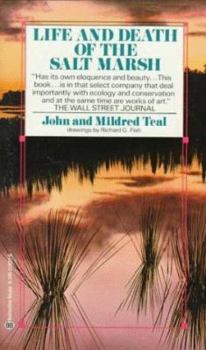
Life and Death of a Salt Marsh


Select Format
Select Condition 
Book Overview
"At low tide, the wind blowing across Spartina grass sounds like wind of the prairie. When the tide is in, the gentle music of moving water is added to the prairie rustle.... " One of nature's... This description may be from another edition of this product.
Format:Mass Market Paperback
Language:English
ISBN:0345310276
ISBN13:9780345310279
Release Date:July 1983
Publisher:Ballantine Books
Length:274 Pages
Weight:0.36 lbs.
Dimensions:0.8" x 4.2" x 6.9"
Customer Reviews
4 ratings
A few feet above high tide from Maine to Florida
Published by Thriftbooks.com User , 23 years ago
The book promotes an awareness of the salt marsh ... from glacial history to the hunting of doughbirds (Eskimo curlews). Though salt marshes don't have high species diversity, the Teal's cover the range from Spartina and Juncus plants (and sawgrass in Florida), to the economically important Blue Crabs, to annoying insects like greenheads and deerfly. From the salt marsh detritus, is the nutrient soup that becomes the basis for the shrimp and mullet we love to eat. The Teals also offer conservation ideas. When the book was written (1969), DDT was not yet banned. The chapter on mosquito control is enlightening ... and with the occurrence of West Nile Virus, there will be more pressure on mosquito control, so one hopes it is balanced. The history of marsh destruction in Boston is illustrative. The good news is that in the 1950's the rate of coastal wetland loss was about 46,000 acres/year, but today it is around 20-25,000 per year. Unfortunately pressures of coastal development continue. This book helps me feel lucky to live near Florida "Big Bend" with large stretches of Gulf salt marsh from the Ochlockonee River south to St. Petersburg.
THEY PRACTICED WHAT THEY PREACHED
Published by Thriftbooks.com User , 25 years ago
Sometime between 1970 and 1975, my family and I spent a week with friends who lived in Falmouth, on Cape Cod. Because one of our friends was a Marine Biologist at Wood's Hole Oceanographic Institute and worked with John Teal, one of the authors of this book, we were lucky enough to attend a Fourth of July Celebration at the Teal's farm.John and Mildred had purchased a colonial era Cape Cod farmhouse and the hundred or so acres that surrounded it. Other than hot and cold running water, electricity and natural gas, and a slightly modernized kitchen (i.e. the stove used gas rather than burning wood), the house looked much as it had when it had been built.As might be expected, the Teal's Independence Day celebration was ecologically sound and reflected the era in which the farmhouse was built. The children got rides on one of the more tame domesticated goats, the women competed in tossing a rolling pin for distance and accuracy, and the men tried out old fashioned farm implements. The food was prepared from hand gathered and harvested local foods. For instance we had mussel salad made from mussels that I had help gather the day before. There were cranberries from one of the Cape's cranberry bogs, and quahogs and oysters dug up just long enough ago to let them naturally filter out the sand.The point of all this is that the Teals believed in and acted on the ecological and preservationist principles that they espoused in their book. In LIFE AND DEATH OF THE SALT MARSH, they do a wonderful job of discussing how a salt marsh is formed, how long it takes, and how ecologically fragile it is. They make the point that man can, and does, destroy in a decade or less what it has taken nature centuries to build. Since, as they point out, the salt marshes play an important part in nature's food chain and ultimately in the life cycles of many species, when we damage or destroy these natural habitats, the consequences can be disastrous.If we all could live a little more like the Teals were living, our children and their children might still have some of nature's bounty left to enjoy in future years.It is my opinion that this is one of those books that ought to be compulsory reading for every thinking human being.
Wonderful description of a vanishing paradise
Published by Thriftbooks.com User , 27 years ago
I often visit salt marshes in my kayak in the Cape May (NJ) area. This book has enhanced my enjoyment by allowing me to more fully understand my experiences in the wetlands. Read the book and get on your kayak!
Lots of info on the ecology of the salt marsh ecosystem.
Published by Thriftbooks.com User , 27 years ago
Life and Death of the Salt Marsh. Teal, John and Mildred. Atlantic Monthly Press, Boston. 1969. Life and Death of the Salt Marsh is a book that focuses on many aspects of the ecology of the salt marsh. To quote the authors, it is "about the marshes of the East Coast of North America: how they were formed; why they continue to exist; the interplay of plants and animals; and the effect of that influential animal, man." This book does a very thorough job of covering all these topics. It begins with the story of one particular salt marsh, how it formed, what happened to it when colonists first arrived and used it for hay production, and its eventual death after human impact became so great as to prevent marsh recovery. The remainder of the book gives detailed descriptions of the processes and organisms that affect the salt marsh. These include the geology, history of glaciation, plant and animal species, seasons, and topics relating to marsh pollution and conservation. Considering that this book was written in 1969, thirty years ago, it still seems to have good scientific accuracy. The details concerning the geology and species of the marsh probably have not changed much in the past thirty years. The dominant species of the salt marsh are the Spartina grasses. These grasses were often gathered as feed for livestock during early settlement. Many birds make there home in the salt marsh and were often hunted for food. It is interesting to look at this book from a historical perspective, especially the sections on conservation. Preservation of marshes is important for many reasons. The main reason for preservation being that a large variety of species rely on salt marshes during part or all of their life cycle. Many of these species are commercially viable and are (or were when the book was written) important to the East Coast economy. The chapter on pollution control was very interesting because it includes discussion of the use of DDT. Most ecologist today have heard of or read Silent Spring and know about the dangers of DDT. Life and Death of the Salt Marsh was written just before Silent Spring, by Janet Carson, and brings up the many dangers and harmful side effects of DDT. Obvious DDT was an area of concern for many people in fields related to ecology in the late 60's. It is interesting that a recommendation is made to use only minimum levels of DDT is specific areas, instead of a complete discontinuation of its use. The entire book could be related to many aspects of ecology and is thus relevant to anyone interested in the ecology of salt marshes. The first section of the book, the actual story of the life and death of a specific salt marsh, is easy to read and entertaining. It provides an overview of much of the information presented later in greater detail. I would recommend just Part 1 to any one interested in an overview of marshes and the effects of human settlement near or
Copyright © 2026 Thriftbooks.com Terms of Use
| Privacy Policy | Do Not
Sell/Share My Personal Information | Cookie Policy | Cookie Preferences | Accessibility Statement
ThriftBooks® and the ThriftBooks® logo are registered trademarks of Thrift Books Global, LLC
ThriftBooks® and the ThriftBooks® logo are registered trademarks of Thrift Books Global, LLC
