


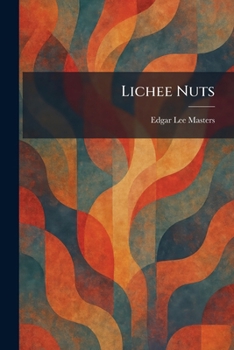
Lichee Nuts

Select Format
Select Condition 
Book Overview
"Lichee Nuts" is a compelling collection of poetry and sketches by Edgar Lee Masters, the acclaimed author of "Spoon River Anthology." Shifting his focus from the rural Midwest to the vibrant streets of New York City's Chinatown, Masters captures the observations and philosophies of various characters, primarily Chinese immigrants, as they navigate and critique American life and Western thought.
Through a series of brief, pithy poems and vignettes, the work explores universal themes of wisdom, irony, and the human condition. Written with sharp wit and an economy of language, "Lichee Nuts" presents a unique cross-cultural perspective, contrasting ancient Eastern sensibilities with the complexities of early 20th-century urban America. The poems serve as concentrated meditations on social politics and personal identity, capturing the voices of a community through a lens of empathy and intellectual curiosity. This collection remains a significant example of Masters' ability to distill complex social commentary into evocative verse, providing a fascinating literary glimpse into the multicultural fabric of historical New York.
This work has been selected by scholars as being culturally important, and is part of the knowledge base of civilization as we know it. This work was reproduced from the original artifact, and remains as true to the original work as possible. Therefore, you may see the original copyright references, library stamps (as most of these works have been housed in our most important libraries around the world), and other notations in the work.
This work is in the public domain in the United States of America, and possibly other nations. Within the United States, you may freely copy and distribute this work, as no entity (individual or corporate) has a copyright on the body of the work.
As a reproduction of a historical artifact, this work may contain missing or blurred pages, poor pictures, errant marks, etc. Scholars believe, and we concur, that this work is important enough to be preserved, reproduced, and made generally available to the public. We appreciate your support of the preservation process, and thank you for being an important part of keeping this knowledge alive and relevant.
Customer Reviews
ThriftBooks ® and the ThriftBooks ® logo are registered trademarks of Thrift Books Global, LLC
