


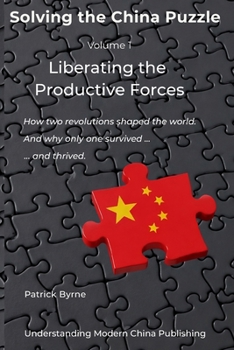
Liberating the Productive Forces: How two revolutions shaped the world. And why only one survived - and thrived.
No Customer Reviews

Liberating the Productive Forces examines China's development from the Revolution to the present, using nearly fifty years of reform-era outcomes to reassess the successes and failures of socialist construction. Drawing on China's unique historical record, the book argues that the key to understanding China's achievements lies not in abstract ideology but its adoption of a scientific approach to economic management. China's experience provides the first long-term vantage point from which different socialist strategies can be compared, revealing why some approaches succeeded while others produced crisis or collapse. The book identifies several early shortcomings in Marxist forecasts that became visible only in hindsight. These included a premature writing off of farmers and other small-scale producers, and the lack of a scientific method for evaluating policy outcomes. These limitations strongly limited the direction of both the Soviet Union and Mao-era China, contributing to food crises, political instability, and the inability to adapt institutions to real economic conditions. Through a comparative analysis of Soviet and Chinese development, the book shows how the Soviet abandonment of Lenin's New Economic Policy removed the only viable foundation for socialist progress in an agrarian society. China's post-1978 reforms, by contrast, revived the essential logic of the NEP: incentivising farmers, encouraging small-scale producers, opening up to foreign investment, experimenting with policy, and adjusting strategy based on results. This scientific approach liberated China's productive forces and demonstrated that socialist development is possible when grounded in economic realities. The book also examines the excesses of China's reform process - inflation, rising inequality, weakened welfare systems, corruption, and environmental strain - and the subsequent course corrections undertaken in the 2000s. It concludes that China today remains a socialist system that makes extensive use of markets while retaining public ownership and strategic state direction. As the first volume in a three-part series, this book explains why China succeeded where the Soviet Union did not, and thereby establishes the analytical foundation for the volumes that follow.
Format:Paperback
Language:English
ISBN:B0H46LKJDF
ISBN13:9798996124213
Release Date:June 2026
Publisher:Understanding Modern China Publishing
Length:532 Pages
Weight:1.40 lbs.
Dimensions:1.3" x 6.0" x 9.0"
Customer Reviews
0 rating
Copyright © 2026 Thriftbooks.com
Terms of Use | Privacy Policy | Do Not Sell/Share My Personal Information | Cookie Policy | Cookie Preferences | Accessibility Statement
ThriftBooks ® and the ThriftBooks ® logo are registered trademarks of Thrift Books Global, LLC
ThriftBooks ® and the ThriftBooks ® logo are registered trademarks of Thrift Books Global, LLC
