


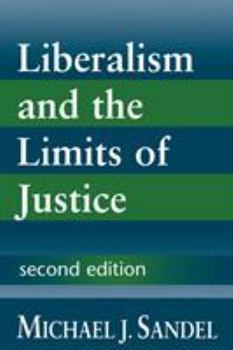
Liberalism and the Limits of Justice


Select Format
Select Condition 
Book Overview
Revised
Format:Paperback
Language:English
ISBN:0521567416
ISBN13:9780521567411
Release Date:March 1998
Publisher:Cambridge University Press
Length:252 Pages
Weight:0.85 lbs.
Dimensions:0.7" x 5.9" x 9.0"
Customer Reviews
1 rating
A must-read for anyone even remotely interested in poitics, morals, and law
Published by Thriftbooks.com User , 18 years ago
A dense but not a difficult read, Sandel's Liberalism and the Limits of Justice (LLJ) is a useful introduction to political and moral reasoning. The primary purpose of the book is to bring to the forefront the fundamental weaknesses of the liberalist position as according to Rawls, which LLJ succeeds in doing. The book is, however, not a full-on frontal assault on Rawlsian Liberalism, but a thought provoking challenge to its assumptions and logical inconsistencies. Particularly enguaging is the discussion of the notion of Personhood and how Rawls wavers on his application of that concept to his concept of Justice.
Copyright © 2026 Thriftbooks.com
Terms of Use | Privacy Policy | Do Not Sell/Share My Personal Information | Cookie Policy | Cookie Preferences | Accessibility Statement
ThriftBooks ® and the ThriftBooks ® logo are registered trademarks of Thrift Books Global, LLC
ThriftBooks ® and the ThriftBooks ® logo are registered trademarks of Thrift Books Global, LLC
