


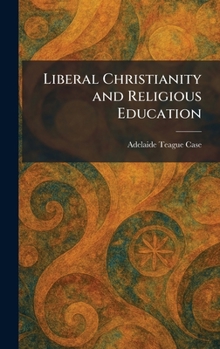
Liberal Christianity and Religious Education

"Liberal Christianity and Religious Education" is a seminal examination of the evolving relationship between progressive theology and pedagogical practice. Written during a transformative era for American Protestantism, Adelaide Teague Case explores the fundamental principles of liberal Christianity and their practical application within the realm of religious instruction. The work delves into the necessity of reconciling traditional faith with modern scientific understanding and democratic ideals, advocating for an educational approach that encourages critical inquiry rather than rote memorization.
Case meticulously analyzes the objectives of religious education, questioning how spiritual growth can be fostered in a way that remains socially relevant and intellectually honest. By bridging the gap between academic theology and the classroom, this book serves as a foundational text for understanding the development of modern religious pedagogy. It emphasizes the role of the Social Gospel and the importance of preparing students to engage meaningfully with the ethical challenges of the contemporary world. For scholars, educators, and those interested in the history of religious thought, this work offers a profound look at the attempts to modernize Christian education for a changing society.
This work has been selected by scholars as being culturally important, and is part of the knowledge base of civilization as we know it. This work was reproduced from the original artifact, and remains as true to the original work as possible. Therefore, you may see the original copyright references, library stamps (as most of these works have been housed in our most important libraries around the world), and other notations in the work.
This work is in the public domain in the United States of America, and possibly other nations. Within the United States, you may freely copy and distribute this work, as no entity (individual or corporate) has a copyright on the body of the work.
As a reproduction of a historical artifact, this work may contain missing or blurred pages, poor pictures, errant marks, etc. Scholars believe, and we concur, that this work is important enough to be preserved, reproduced, and made generally available to the public. We appreciate your support of the preservation process, and thank you for being an important part of keeping this knowledge alive and relevant.
Customer Reviews
ThriftBooks ® and the ThriftBooks ® logo are registered trademarks of Thrift Books Global, LLC
