


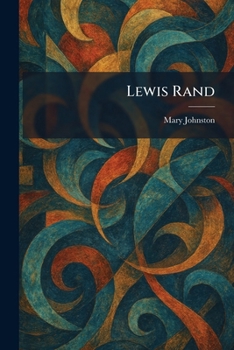
Lewis Rand

Select Format
Select Condition 
Book Overview
"Lewis Rand" is a compelling historical novel set against the vibrant and volatile backdrop of post-Revolutionary Virginia. Written by Mary Johnston, a master of the genre, the story follows the eponymous protagonist, a brilliant and ambitious self-made man who rises from a modest background to become a formidable lawyer and politician. As Rand navigates the complex social and political hierarchies of the early nineteenth century, he finds himself caught between the conflicting ideologies of the era's giants, including Thomas Jefferson and Aaron Burr.
The narrative masterfully explores themes of personal ambition, moral conflict, and the shifting loyalties of a young nation. Johnston provides a rich portrayal of the Federal period, capturing the intense political rivalries and the high-stakes intrigue surrounding the Burr conspiracy. Through the lens of Rand's professional ascent and his complicated personal life, the novel examines the tensions between democratic ideals and individual power. "Lewis Rand" stands as a significant work of historical fiction, offering readers a nuanced perspective on the forging of the American political identity and the human cost of political desire.
This work has been selected by scholars as being culturally important, and is part of the knowledge base of civilization as we know it. This work was reproduced from the original artifact, and remains as true to the original work as possible. Therefore, you may see the original copyright references, library stamps (as most of these works have been housed in our most important libraries around the world), and other notations in the work.
This work is in the public domain in the United States of America, and possibly other nations. Within the United States, you may freely copy and distribute this work, as no entity (individual or corporate) has a copyright on the body of the work.
As a reproduction of a historical artifact, this work may contain missing or blurred pages, poor pictures, errant marks, etc. Scholars believe, and we concur, that this work is important enough to be preserved, reproduced, and made generally available to the public. We appreciate your support of the preservation process, and thank you for being an important part of keeping this knowledge alive and relevant.
Customer Reviews
ThriftBooks ® and the ThriftBooks ® logo are registered trademarks of Thrift Books Global, LLC
