


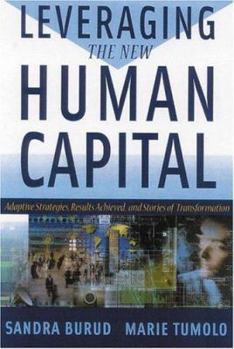
Leveraging the New Human Capital: Adaptive Strategies, Results Achieved, and Stories of Transformation

Select Format
Select Condition 
Book Overview
Leveraging the New Human Capital forever changes the way managers see today's highly complex employees. Through interviews with corporate executives, overviews of available research and four stories... This description may be from another edition of this product.
Format:Hardcover
Language:English
ISBN:089106205X
ISBN13:9780891062059
Release Date:October 2004
Publisher:UNKNO
Length:350 Pages
Weight:1.70 lbs.
Dimensions:9.2" x 1.1" x 6.1"
Customer Reviews
2 ratings
Unusually clear, stimulating and valuable
Published by Thriftbooks.com User , 15 years ago
This is an unusually well written treatise on human resources. The focus is on the value of human capital in the modern economy. Although academically commissioned the intent is practical. It would be a good thing if CEOs of giant corporations as well as heads of mom and pop enterprises would put their laptops aside on that cross-country flight and read this book instead. They wouldn't be bored, and they would likely to do themselves and their business a big favor as they learn how to manage their most important and most valuable resource, their employees. The style of the book is engaging, vivid, concrete and clear. I have seldom run across a book on the business/labor/economics spectrum that is as engagingly written, and I've read a more than a few. The thesis in a nutshell is this: as we have moved from an industrial economy to a knowledge- or information-based economy, we have at the same time evolved a workforce that is--as Burud and Tumolo phrase it--comprised of "a different animal." This new "animal" (their metaphor uses giraffes and elephants) does not, as once was the case, devote his or her entire life to the corporation. Instead today's human resource is a "dual-focus" person who has a lifestyle that balances work and a life away from work. When I first picked up this book I expected the usual celebration of the "new" capital in the work place, that is, women. And I expected some guidance on how today's management might best understand and work with women as opposed to the traditional employee who was usually male. But Sandra Burud and Marie Tumolo have gone beyond that quasi-political position and made it clear that today's human resource, whether male or female, is the elephant in the office who is of enormous value, and regardless of sex will be giving some very real quality time to home and family. So what's a CEO to do? The authors make it clear that management must work with its human capital in a manner that respects the entire human being while recognizing that this human being is their most valuable resource. I've repeated myself, but this really is the crux of the matter. The old style management that expected 70 hour weeks and no life outside the umbrella of my father (and mother!) the corporation, must think again. This doesn't mean that management is getting a divided or a compromised effort from its new (and more enlightened, I must say, employees) but in fact is getting more since today's worker is sophisticated, can "self-organize" and work with others to create added value in a way that was not possible in earlier generations. Management must recognize that their employees are "biological systems seeking to fulfill their needs and aspirations" (p. 16, quoting C. Ehin from "Unleashing Intellectual Capital," 2000) and not machines. The question might arise why is this happening now? And the answer is that in today's complex and highly competitive, interactive and interdependent global economy, it is h
EXCELLENT GRAND TOUR OF NEW IDEAS FOR ORGANIZATION & HRM
Published by Thriftbooks.com User , 20 years ago
An ambitious overview of new approaches to human resources. Key to the book are five adaptive strategies: choosing to invest in people; adopting a new set of beliefs; redefining organizational culture; transforming management practices; and ensuring a fit between the first four strategies based on purpose, culture, and management practices and policies. The adaptive strategies involve rethinking how to achieve business results, reexamining how work is organized, and transforming how people are managed. The book concludes with the effects of adaptive cultures and practices on organizational performance. We at Stern's Management Review (www.FutureOrganization) find this to be an excellent grand tour of new ideas and practices in organization and human resource management. As a premium, the book includes extensive references, making it all the more valuable.
Copyright © 2025 Thriftbooks.com
Terms of Use | Privacy Policy | Do Not Sell/Share My Personal Information | Cookie Policy | Cookie Preferences | Accessibility Statement
ThriftBooks ® and the ThriftBooks ® logo are registered trademarks of Thrift Books Global, LLC
ThriftBooks ® and the ThriftBooks ® logo are registered trademarks of Thrift Books Global, LLC
