


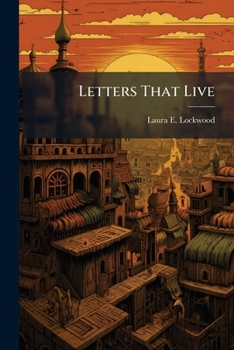
Letters That Live

Select Format
Select Condition 
Book Overview
"Letters That Live" is a carefully curated collection of correspondence from pivotal figures throughout history, offering readers an intimate glimpse into their thoughts, experiences, and the events that shaped their lives. Selected and introduced by Laura E. Lockwood, this compilation spans centuries and continents, presenting letters that are not only historically significant but also reveal the personal dimensions of their authors. From eloquent expressions of love and friendship to urgent dispatches from the battlefield and profound reflections on life and death, these letters capture the essence of human experience across time.
Lockwood's thoughtful selection emphasizes the power of the written word to transcend time and connect readers with the past in a deeply personal way. This volume serves as both a historical resource and a testament to the enduring art of letter-writing. A valuable addition to any library, "Letters That Live" promises to inspire and enlighten readers with its poignant and often surprising insights into the lives of those who came before us.
This work has been selected by scholars as being culturally important, and is part of the knowledge base of civilization as we know it. This work was reproduced from the original artifact, and remains as true to the original work as possible. Therefore, you will see the original copyright references, library stamps (as most of these works have been housed in our most important libraries around the world), and other notations in the work.
This work is in the public domain in the United States of America, and possibly other nations. Within the United States, you may freely copy and distribute this work, as no entity (individual or corporate) has a copyright on the body of the work.
As a reproduction of a historical artifact, this work may contain missing or blurred pages, poor pictures, errant marks, etc. Scholars believe, and we concur, that this work is important enough to be preserved, reproduced, and made generally available to the public. We appreciate your support of the preservation process, and thank you for being an important part of keeping this knowledge alive and relevant.
Customer Reviews
ThriftBooks® and the ThriftBooks® logo are registered trademarks of Thrift Books Global, LLC
