


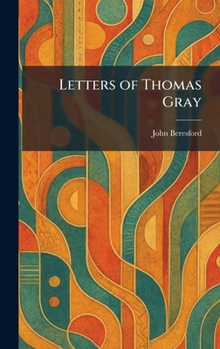
Letters of Thomas Gray

"Letters of Thomas Gray" offers an intimate and scholarly look into the private world of one of the eighteenth century's most significant poets. While Thomas Gray is immortalized for his masterpiece, "Elegy Written in a Country Churchyard," his extensive correspondence reveals a man of profound intellect, wit, and sensitivity. These letters provide a rich narrative of his life at Cambridge, his travels across Europe, and his deep engagement with the literature, history, and natural science of his day.
This collection, curated by John Beresford, illuminates Gray's complex character, moving beyond his reputation as a reclusive academic to show his capacity for deep friendship and sharp social observation. The correspondence serves as a vital historical record of the Georgian literary landscape, featuring Gray's thoughts on his contemporaries and the evolving aesthetic tastes of the 1700s. Readers will find in these pages a masterful display of the epistolary art, where personal reflection meets scholarly rigor. "Letters of Thomas Gray" remains an essential volume for those seeking to understand the man behind the verses and the intellectual pulse of his era.
This work has been selected by scholars as being culturally important, and is part of the knowledge base of civilization as we know it. This work was reproduced from the original artifact, and remains as true to the original work as possible. Therefore, you may see the original copyright references, library stamps (as most of these works have been housed in our most important libraries around the world), and other notations in the work.
This work is in the public domain in the United States of America, and possibly other nations. Within the United States, you may freely copy and distribute this work, as no entity (individual or corporate) has a copyright on the body of the work.
As a reproduction of a historical artifact, this work may contain missing or blurred pages, poor pictures, errant marks, etc. Scholars believe, and we concur, that this work is important enough to be preserved, reproduced, and made generally available to the public. We appreciate your support of the preservation process, and thank you for being an important part of keeping this knowledge alive and relevant.
Customer Reviews
ThriftBooks ® and the ThriftBooks ® logo are registered trademarks of Thrift Books Global, LLC
