


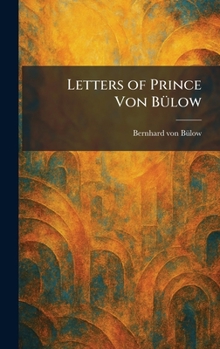
Letters of Prince Von BÃ1/4low

"Letters of Prince Von B 1/4low" offers an intimate and revelatory look into the inner workings of the German Empire during one of its most critical eras. As the former Chancellor of Germany, Bernhard von B 1/4low occupied a central position in European politics at the turn of the 20th century. This collection of personal and official correspondence provides firsthand insights into the diplomatic maneuvers, political alliances, and internal tensions that shaped the reign of Kaiser Wilhelm II and set the stage for the First World War.
Through these letters, readers gain a deeper understanding of B 1/4low's sophisticated, yet often controversial, approach to statecraft. The text covers a wide array of topics, from high-level foreign policy and colonial ambitions to the interpersonal dynamics of the German court. His writings reveal the complexities of maintaining the balance of power in Europe while navigating the unpredictable temperament of the Emperor. "Letters of Prince Von B 1/4low" serves as an essential primary source for historians and students of European history, offering a rare perspective on the leadership and legacy of a statesman who profoundly influenced the course of modern Germany.
This work has been selected by scholars as being culturally important, and is part of the knowledge base of civilization as we know it. This work was reproduced from the original artifact, and remains as true to the original work as possible. Therefore, you may see the original copyright references, library stamps (as most of these works have been housed in our most important libraries around the world), and other notations in the work.
This work is in the public domain in the United States of America, and possibly other nations. Within the United States, you may freely copy and distribute this work, as no entity (individual or corporate) has a copyright on the body of the work.
As a reproduction of a historical artifact, this work may contain missing or blurred pages, poor pictures, errant marks, etc. Scholars believe, and we concur, that this work is important enough to be preserved, reproduced, and made generally available to the public. We appreciate your support of the preservation process, and thank you for being an important part of keeping this knowledge alive and relevant.
Customer Reviews
ThriftBooks ® and the ThriftBooks ® logo are registered trademarks of Thrift Books Global, LLC
