


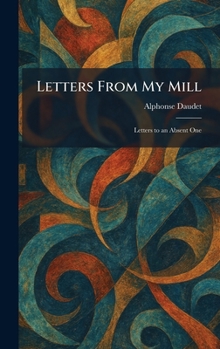
Letters From My Mill: Letters to an Absent One

"Letters From My Mill & Letters to an Absent One" brings together two evocative collections by the celebrated French author Alphonse Daudet. In "Letters From My Mill", Daudet transports readers to the sun-drenched landscapes of Provence, capturing the essence of rural life through a series of charming, witty, and often poignant sketches. These stories, inspired by the folklore and atmosphere of the French countryside, explore themes of tradition, nature, and the human spirit with a timeless, lyrical touch.
Contrasting this pastoral idyll, "Letters to an Absent One" offers a more somber reflection on the realities of the Franco-Prussian War. Through these letters, Daudet provides a personal and moving account of the conflict's impact on French society, blending journalistic observation with deep emotional resonance. Together, these works showcase Daudet's remarkable versatility as a writer, moving seamlessly between light-hearted regionalism and the gravity of historical upheaval. This volume is an essential collection for those interested in 19th-century French literature, offering a vivid portrait of both the tranquility of the provinces and the turbulence of war.
This work has been selected by scholars as being culturally important, and is part of the knowledge base of civilization as we know it. This work was reproduced from the original artifact, and remains as true to the original work as possible. Therefore, you may see the original copyright references, library stamps (as most of these works have been housed in our most important libraries around the world), and other notations in the work.
This work is in the public domain in the United States of America, and possibly other nations. Within the United States, you may freely copy and distribute this work, as no entity (individual or corporate) has a copyright on the body of the work.
As a reproduction of a historical artifact, this work may contain missing or blurred pages, poor pictures, errant marks, etc. Scholars believe, and we concur, that this work is important enough to be preserved, reproduced, and made generally available to the public. We appreciate your support of the preservation process, and thank you for being an important part of keeping this knowledge alive and relevant.
Customer Reviews
ThriftBooks ® and the ThriftBooks ® logo are registered trademarks of Thrift Books Global, LLC
