


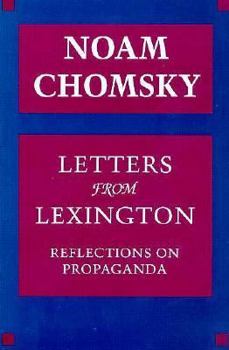
Letters from Lexington: Reflections on Propaganda

Select Format
Select Condition 
Book Overview
Upon its original publication in 1993, Letters from Lexington reaffirmed Noam Chomsky's status as one of the most incisive critics of the American media. Reissued with a new foreword by Chomsky's... This description may be from another edition of this product.
Format:Paperback
Language:English
ISBN:1567510108
ISBN13:9781567510102
Release Date:January 1993
Publisher:Common Courage Pr
Weight:0.56 lbs.
Dimensions:7.5" x 0.5" x 5.0"
Customer Reviews
5 ratings
Cliff Notes for Manufacturing Consent
Published by Thriftbooks.com User , 20 years ago
The double entendre in the title of my review is intentional. Chomsky's letters not only sketch how the USA government manufactured domestic consent for its foreign policies during the early 1990s, it also (perhaps intentionally?) adumbrates by demonstration the salient aspects of the "propaganda model" Chomsky and Edward Herman explored in considerable depth in their work *Manufacturing Consent*. As for the content of the work, I recommend that readers consult the excellent reviews by Chris Green (always, always read his reviews), Egalitarian, and "Reader" (10.10.99) on this page. I couldn't possibly improve on them. One last observation: Chomsky resides in Lexington, but I can't help but wonder if the title selection plays on the historical significance Lexington has as the location for the beginning of the American Revolution. Perhaps I am poeticizing the title. Nevertheless, I am quite certain that this work will make the canon of literary political dissent as so many of Chomsky's works have already done.
New edition of old Chomsky observations on foreign affairs.
Published by Thriftbooks.com User , 21 years ago
Chomsky writes that the Sandinistas won an election in November 1984 widely perceived as free and fair but U.S. elites put this down the memory hole. Michael Kinsley noted the "Orwellian" rhetoric of the Reaganites in blaming the Sandinistas for Nicargua's ruined economy, after it had been the official policy of the U.S. backed contras to destroy it. But he praised Nicaragua's 1990 elections as free and fair. Anthony Lewis praised the elections too but criticized the Central American policies of the administration--which included the economic embargo on Nicaragua supported by liberals like him. Chomsky quotes the UNO economist Fransisco Mayorga as estimating that the embargo cost Nicaragua 3 billion. The implications suggesting that the U.S. is a terrorist state in that it was telling the Nicaraguan people that Contra terror and the embargo would continue unless they voted out the Sandinistas in Feb. 1990, was not noticed in the U.S. media. Indeed Time magazine celebrated the attacks on Nicaraguan civilian infrastructure i.e. U.S./contra war crimes as causing the Sandinistas to be voted out. The killing of the poor by the U.S. backed security forces in El Salvador and Guatemala, which ran elections under extreme terror, received little sustained attention. Chomsky observes that Laurence Pezullo, while the last U.S. ambassador to Somoza, had advised the National Guard to continue its final mass murder operations which were killing tens of thousands. After Carter couldn't prevent the Sandinistas from taking power, the National Guard, the future Contras, were flown out in U.S. military planes with Red Cross markings (a war crime). The media had nothing to say about the U.S. successfully pressuring the new UNO government in Nicaragua after 1990 to drop its demand that the U.S. comply with the World Court ruling of 1986 that the U.S. stop terrorizing Nicaragua and pay 17 billion dollars in reparations. After the U.S. withheld desperately needed aid, the Chamarro government dropped its demand for U.S. compliance The media suppressed that evidence of Libyan involvement in the murder of one American that led to the "retaliation" against Libya in 1986 which killed many dozens of civilians, was non-existent according to the West Germans. . Chomsky writes that likewise evidence for Libyan involvement in the Lockerbie bombing is negligible (and years later this is still the truth, see--William .Blum's new book "Freeing the World to Death). In any case, Lockerbie may have been "retaliation" for the U.S. shooting down an Iranian civilian airliner in 1988, killing 290. The commander of a nearby vessel, David Carlson later wrote that the Iranian plane was clearly civilian.and not acting otherwise.. The shoot down, by the U.S.S. Vincennes, Carlson suggested,was designed to test the ship's Aegis missile system. This atrocity was the culmination of U.S. support for Saddam in the Iran-Iraq war; for a few days later Iran capitulated to a cease fire on Ira
illuminates Chomsky's dissident analysis
Published by Thriftbooks.com User , 25 years ago
"Letters from Lexington : Reflections on Propaganda" is a compelling collection of letters which reveal the role of the US major media in justifying and championing US government and corporate actions throughout the world. One chapter which illuminates Chomsky's dissident analysis is the chapter entitled, "The PC Thought Police". In this chapter, Chomsky compares the US propaganda system to that of Brezhnev's USSR:"In the study of any system, it is often useful to look at something radically different, to highlight crucial features. Let's begin, then, by looking at a society that is close to the opposite pole from ours: Brezhnev's USSR. Consider policy formation. In Brezhnev's USSR, economic policy was determined in secret, by centralized power; popular involvement was nil, except marginally, through the Communist Party. Political policy was in the same hands. The political system was meaningless, with virtually no flow from bottom to top. Consider next the information system, inevitably constrained by the distribution of economic-political power. In Brezhnev's USSR there was a spectrum, bounded by disagreements within centralized power. True, the media were never obedient enough for the commissars. Thus they were bitterly condemned for undermining public morale during the war in Afghanistan, playing into the hands of the imperial aggressors and their local agents from whom the USSR was courageously defending the people of Afghanistan. For the totalitarian mind, no degree of servility is ever enough. There were dissidents and alternative media: underground samizdat and foreign radio. According to a 1979 US government-funded study, 77% of blue-collar workers and 96% of the middle elite listened to foreign broadcasts, while the alternative press reached 45% of high-level professionals, 41% of political leaders, 27% of managers, and 14% of blue-collar workers. The study also found most people satisfied with living conditions, favoring state-provided medical care, and largely supportive of state control of heavy industry; emigration was more for personal than political reasons.Dissidents were bitterly condemned as "anti-Soviet" and "supporters of capitalist imperialism," as demonstrated by the fact that they condemned the evils of the Soviet system instead of marching in parades denouncing the crimes of official enemies. They were also punished, not in the style of US dependencies such as El Salvador, but harshly enough. The concept "anti-Soviet" is particularly striking. We find similar concepts in Nazi Germany, Brazil under the generals, and totalitarian cultures generally. In a relatively free society, the concept would simply evoke ridicule. Imagine, say, that Italian critics of state power were condemned for "anti-Italianism." Such concepts as "anti-Soviet" are the very hallmark of a totalitarian culture; only the most dedicated and humorless commissar could use such terms. Well-behaved party hacks were guilty of no such crimes as anti-Sovietism
One thumb up, way up.
Published by Thriftbooks.com User , 26 years ago
Chomsky is the American Empire's worst enemy. Like anyone who challenges powerful interests and their claims to authority, he has been the target of an unrelenting, but increasingly ineffectual (sometimes comical), smear campaign. Noam Chomsky is a national treasure and a credit to the human species. Read Chomsky's "Letters", or anything else by one of the world's leading advocates for democracy and freedom.
Chomsky at his Best and most accessible
Published by Thriftbooks.com User , 27 years ago
This short book is lucidly written and full of Chomsky's subtle humor. It is Chomsky at his best and most accessible.
Copyright © 2026 Thriftbooks.com
Terms of Use | Privacy Policy | Do Not Sell/Share My Personal Information | Cookie Policy | Cookie Preferences | Accessibility Statement
ThriftBooks ® and the ThriftBooks ® logo are registered trademarks of Thrift Books Global, LLC
ThriftBooks ® and the ThriftBooks ® logo are registered trademarks of Thrift Books Global, LLC
