


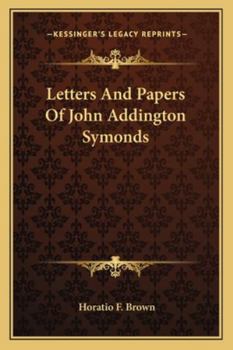
Letters And Papers Of John Addington Symonds
No Customer Reviews

Select Format
Select Condition 
Book Overview
The book ""Letters And Papers Of John Addington Symonds"" is a collection of letters and papers written by John Addington Symonds, a prominent Victorian writer and critic. The book is edited by Horatio F. Brown and provides readers with an insight into Symonds' personal and professional life. The letters and papers cover a wide range of topics, including Symonds' literary works, his travels, his relationships with family and friends, and his struggles with his sexuality. The book also includes a biographical introduction by Brown, providing readers with background information on Symonds' life and career. Overall, ""Letters And Papers Of John Addington Symonds"" offers a fascinating glimpse into the life of a significant figure in Victorian literature and culture.This scarce antiquarian book is a facsimile reprint of the old original and may contain some imperfections such as library marks and notations. Because we believe this work is culturally important, we have made it available as part of our commitment for protecting, preserving, and promoting the world's literature in affordable, high quality, modern editions, that are true to their original work.
Format:Paperback
Language:English
ISBN:116319395X
ISBN13:9781163193952
Release Date:September 2010
Publisher:Kessinger Publishing
Length:296 Pages
Weight:0.88 lbs.
Dimensions:0.6" x 6.0" x 9.0"
Customer Reviews
0 rating
Copyright © 2026 Thriftbooks.com
Terms of Use | Privacy Policy | Do Not Sell/Share My Personal Information | Cookie Notice | Cookie Preferences | Accessibility Statement
ThriftBooks ® and the ThriftBooks ® logo are registered trademarks of Thrift Books Global, LLC
ThriftBooks ® and the ThriftBooks ® logo are registered trademarks of Thrift Books Global, LLC
