


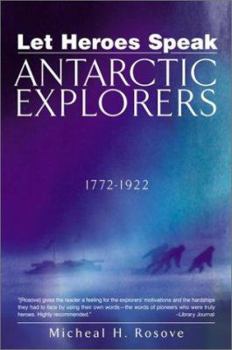
Let Heroes Speak: Antartic Explorers 1772-1922

Select Format
Select Condition 
Book Overview
Over the centuries, many intrepid souls have journeyed to the forbidding south polar regions. In this single volume, Michael H. Rosove tells their stories, voyage by voyage, in language that's accessible to the general reader yet holds the attention of serious polar buffs and scholars. An exciting compendium of true tales...Each journey's preparations are described meticulously. Rosove is precise about dates and geography. A lucid, useful reference book on the Antarctic. (The Palm Beach Post) An excellent detailed account of the early explorers of the Antarctic continent...Rosove's love for the Antarctic is apparent in his treatment of these exploring pioneers, whose hardships can hardly be imagined today. (John Splettstoesser, geologist and Antarctica expert) Rosove] gives the reader a feeling for the explorers' motivations and the hardships they had to face by using their own words-the words of pioneers who were truly heroes. Highly recommended. (Library Journal)
Format:Paperback
Language:English
ISBN:0425183300
ISBN13:9780425183304
Release Date:February 2002
Publisher:Berkley Trade
Length:384 Pages
Weight:0.94 lbs.
Dimensions:9.0" x 1.0" x 6.0"
Customer Reviews
2 ratings
Palm Beach Post Review by Michael Browning
Published by Thriftbooks.com User , 24 years ago
Rosove stays modestly in the background and lets his explorers, who were often excellent prose stylists, speak for themselves. He quotes judiciously from diaries, ships' logs and published accounts of journeys so desperate that explorers ended up eating the rawhide lashings of their sleds, as well as their sled dogs (whose livers contained so much vitamin A that the Australian, Douglas Mawson nearly died of hypervitaminosis, and had to watch as the skin sloughed off his feet in damp shreds). "Here is the sanctuary of sanctuaries, where Nature reveals herself in all her formidable power," wrote one explorer, Jean-Baptiste Charcot. "The man who penetrates his way into these regions feels his soul uplifted." Behind the somewhat mawkish title, lie astonishing feats of bravery, endurance and resourcefulness that make the exploits of modern astronauts seem almost routine. Indeed the parallels between the Antarctic and outer space are eerily similar, with the icebergs resembling asteroid belts that could shatter a ship's hull in a moment, condemning all aboard to death, beyond any hope of rescue. Two of the ships used were actually named Discovery and Challenger. In 1773 the continent was first glimpsed by the British explorer, James Cook, who fully recognized the dangers of the ice: "Surrounded on every side with danger, it was natural for us to wish for day-light. This when it came, served only to increase our apprehensions, by exhibiting to our view, those huge mountains of ice, which in the night, we had passed without seeing." Cook beat a retreat and predicted that "no man will ever venture farther than I have done; and that the lands which may lie to the South will never be explored..." Cook was wrong, of course, but the effort of exploring Antarctica took almost superhuman courage. The explorers came on ships with names like the Erebus, the Terror, the Fram, the Pourquoi Pas?, L'Astrolabe, the Resolution, the Relief and the Aurora. They climbed mountains and volcanoes. They advanced gingerly over chasms spanned by treacherous snow-bridges. They drank snowmelt mixed with dog's blood and slept in caves carved out of ice. They froze to death, starved to death or fell to their deaths in crevasses hundreds of feet deep. They returned to glory, or to oblivion, changed forever by their sojourns on the frozen tip of the planet. Rosove includes the big names like Robert Scott, Roald Amundsen and Ernest Shackleton. But he goes well beyond these giants and includes 20 more explorers, people like James Clark Ross, for whom the Ross Ice Shelf is named; Jean-Baptiste Charcot, who joked that the Antarctic was one place where you never needed to worry that you left your umbrella at home, as it never rained; and Wilhelm Filchner, a German explorer who adapted the auxiliary engine of his ship, the Bjorn, so that its boiler could run off seal blubber and whole penguins, which were flung into the furnace like cordwood (already dead, one hopes). There is a first-day-
Let Heroes Speak
Published by Thriftbooks.com User , 25 years ago
This is a fantastic read.It's about Antarctic explorations beginning with Captain Cook in 1772 through Ernest Shakleton's final effort in 1922, and all those in between -- notably Ross, Scott, Amundsen, Mawson, et al.The subject matter is interesting, of course, but that's not why I am recommending it. After completing the first couple of chapters, I read on because there was nothing else I could do. It is that riveting. Even where I knew the outcome of a particular expedition in advance, I found my heart racing with anticipation. Frankly, it is one of the most exciting books I have ever read.Anyone who enjoys true (supported by 26 pages of notes and bibliography) adventure books, along the line of Perfect Storm, Into Thin Air, Ship of Gold, etc. [ this seems to be a popular genre at present ] will love "Let Heroes Speak".
Copyright © 2026 Thriftbooks.com Terms of Use
| Privacy Policy | Do Not
Sell/Share My Personal Information | Cookie Policy | Cookie Preferences | Accessibility Statement
ThriftBooks® and the ThriftBooks® logo are registered trademarks of Thrift Books Global, LLC
ThriftBooks® and the ThriftBooks® logo are registered trademarks of Thrift Books Global, LLC
