


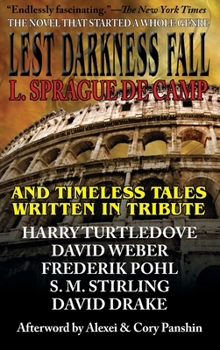
Lest Darkness Fall and Timeless Tales Told in Tribute

Few books have shaped a genre the way Lest Darkness Fall has shaped science fiction. L. Sprague de Camp's novel helped establish alternate history as a subgenre, and the masters of the field have named it a favorite ever since.
Rome, 1938. The archaeologist Martin Padway is standing near the Pantheon when lightning cracks - and drops him into the Rome of 535, a city sliding toward the Dark Ages.
Padway decides to stop it. He starts small: a copper still, a loan from a Syrian banker whose clerks he wins over by teaching them Arabic numerals and double-entry bookkeeping. Then a printing press. A newspaper. A semaphore telegraph strung across Italy. Then a deposed Gothic king who makes him quaestor - and Belisarius, the finest general in Byzantium, marching to take Rome back.
Thematically close to Mark Twain's A Connecticut Yankee in King Arthur's Court, but built on real scholarship. De Camp was a serious student of history and the author of several popular works on the subject. He knew how sixth-century Rome actually worked, down to its banking, and he joined that knowledge to an extraordinary imagination to produce one of the finest time-travel novels ever written.
The book's influence shows in the writers who answered it. The original tribute volume reprinted three stories - by Frederik Pohl, David Drake, and S. M. Stirling - written over forty-three years. This edition adds two brand-new stories by Harry Turtledove and David Weber, plus an afterword by Alexei and Cory Panshin, adapted from their Hugo-winning The World Beyond the Hill.
Customer Reviews
ThriftBooks ® and the ThriftBooks ® logo are registered trademarks of Thrift Books Global, LLC
