


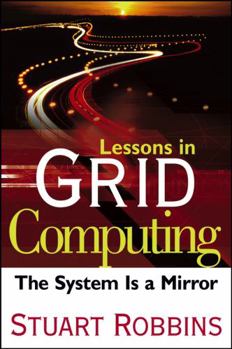
Lessons in Grid Computing: The System Is a Mirror

"You should not overlook the potential genius in this concept."
--Geoffrey Moore, consultant and author, Dealing with Darwin
"Since he first identified 'information systems as mirrors of the people who build them' for me, I have seen it operate in many ways. It is a fascinating idea, and a completely new way of thinking about technology."
--Sean Moriarty, Chief Operating Officer, Ticketmaster
"This book makes for compelling reading--it's easy to become immersed in the stories, and the insights gradually grow in the reader's mind as they take root in the character's minds. This is quite a useful work. The ideas presented here could be quickly put to practical use in any organization."
--Mohamed Muhsin, VP and CIO, The World Bank
A breakthrough exploration of information systems as mirrors of the people who build them.
Packed with truer-than-life stories, stimulating characters, and unique IT analysis, Lessons in Grid Computing finally declares:
* Our systems will not "talk to each other" if our people are not talking to each other
* We must transform ourselves to the same degree that we want to transform our systems
* To correct problems in our information systems, we must first address the problems between the people that build and support them
Discover how to adjust your management style to enable the next generation of technologies with the help of Lessons in Grid Computing.
--Geoffrey Moore, consultant and author, Dealing with Darwin
"Since he first identified 'information systems as mirrors of the people who build them' for me, I have seen it operate in many ways. It is a fascinating idea, and a completely new way of thinking about technology."
--Sean Moriarty, Chief Operating Officer, Ticketmaster
"This book makes for compelling reading--it's easy to become immersed in the stories, and the insights gradually grow in the reader's mind as they take root in the character's minds. This is quite a useful work. The ideas presented here could be quickly put to practical use in any organization."
--Mohamed Muhsin, VP and CIO, The World Bank
A breakthrough exploration of information systems as mirrors of the people who build them.
Packed with truer-than-life stories, stimulating characters, and unique IT analysis, Lessons in Grid Computing finally declares:
* Our systems will not "talk to each other" if our people are not talking to each other
* We must transform ourselves to the same degree that we want to transform our systems
* To correct problems in our information systems, we must first address the problems between the people that build and support them
Discover how to adjust your management style to enable the next generation of technologies with the help of Lessons in Grid Computing.
Format:Hardcover
Language:English
ISBN:0471790109
ISBN13:9780471790105
Release Date:July 2006
Publisher:Wiley
Length:384 Pages
Weight:1.55 lbs.
Dimensions:1.3" x 6.3" x 9.0"
Customer Reviews
4 ratings
Blends storytelling with IT analysis and business insights
Published by Thriftbooks.com User , 19 years ago
Lessons in Grid Computing: The System Is a Mirror blends storytelling with IT analysis and business insights to attract any with affection for computer systems and management alike. The author believes IT systems are mirrors reflecting the dysfunctions and concepts of those who design and manage technology: chapters use fictional surveys to chart real struggles to overcome technical and management issues as a result of such a focus. The idea that computer and social systems are entwined isn't new: what is new is the identification of 'grid computing' to allow readers to understand how this affects organizational structure and achievement. Diane C. Donovan California Bookwatch
Different than what I expected, but far better...
Published by Thriftbooks.com User , 19 years ago
When I ordered this book, I expected it to be a compilation or a series of chapters on the promise of grid computing. What I got was something far different, and much more interesting... Lessons in Grid Computing: The System Is a Mirror by Stuart Robbins. Definitely worth reading and pondering (yes, I do ponder once in awhile)... Contents: 1. The Prime Theorem - Information Systems Mirror the People that Build Them 2. Interfaces - How The Work and What Happens When They Are Broken 3. Relationship Management - We Can No Longer Manage the System as Single Nodes 4. Virtualization - A Natural Stage in the Maturity Cycle of Technologies 5. Orchestration - Finding a Sensible Order Amid Too Many Complications to Count 6. Complexity - Databases, Passwords, Collaboration, Funding, Smashed Atoms, and a Professor 7. Distributed Resources - Two Types of Diffusion - Compute Resources and Human Capital 8. Flash Teams - Analysis of New Organizational Groups from Several Perspectives 9. Network as Narrative Form - Basic Building Blocks Connected to Create Various Structures 10. Identity - Finding the Needle in the Haystack and Giving It a Name 11. Organizational Architecture - How we Organize Ourselves Is as Important as What We Say and Do 12. (Theory of) Resonant Usability - Everything Is Moving to the Presentation Layer, Where Humans Interact 13. Turbulence - Creating Stability in the Face of Chaotic Disruption 14. Libraries - Two Lives, Two Windows, and the Search for Information 15. Abstraction - Lift Yourself Above the Conflicting Details and Look for Similarity 16. Insubordination as an Asset - Why You Must Allow Employees to Disagree with Your Decisions 17. The Consortium - The Multisourced IT Organization and a Software Commons - Our Future 18. The Everysphere - An Example of Synchronous Events between "Unrelated" Objects 19. Q Narratives - Understand the Story and You Will Understand the Business Process 20. Leaving Flatland - To Adjust Somehow after Learning That Your World Has Another Dimension 21. We Are The Platform - Some Final Observations about the System and the Mirror Index Normally I wouldn't go into that level of detail on the table of contents, but I felt the single word chapter headings didn't give a flavor for what was going on. Robbins' premise is our information systems are mirrors of the people and groups that build them, and that management styles must change in order to build and facilitate the next level and generation of computing technology. In other words, "the systems won't talk to each other if the people are not talking to each other." All well and good, and you could easily spend 300 pages in a technical or philosophical discussion on that. But Robbins has effectively written a loosely coupled novel that takes these subjects and explores them in the lives, relationships, and companies of a series of individuals. At first, each chapter seems to be a short story on its own. But soon, characters from previous chapters
Practical Technology Meets Fiction
Published by Thriftbooks.com User , 19 years ago
Despite my being someone with a non-technical background, I found myself loving this book, on a number of different levels, as it puts into practical and realistic stories the many complex theories, applications, and fundamental truths that are at the core of information technology and those people and organizations that make it tick. Having met dozens of CIO's and VP's of Development at firms both huge and small, I never fully understood the context within which they existed until now. Stuart is a practical visionary, and I can honestly say "Lessons in Grid Computing" is probably the most enlightening book I've read all year.
If You Lead an IT Group, Read This Book
Published by Thriftbooks.com User , 19 years ago
If you lead an IT group you will learn something from this book, and it will be so simple that it will change how you see your job from hereafter. I recommend it to anyone who has been around the industry for even just a few years. Stuart Robbins writes as an outsider who clearly has a lot of insider information, when in fact he is an insider with an outsider's perspective. Either way, you're likely see something from your experience presented here in a different light. I will also recommend this book to anyone looking to further enhance their career opportunities in today's quick-paced, technology-enhanced world. The title is misleading in a way. This book is not about technology per se. It is about how we manage technology, and how we might prepare to manage it differently, as both technology and the population that supports it continue to evolve.
Copyright © 2025 Thriftbooks.com
Terms of Use | Privacy Policy | Do Not Sell/Share My Personal Information | Cookie Policy | Cookie Preferences | Accessibility Statement
ThriftBooks ® and the ThriftBooks ® logo are registered trademarks of Thrift Books Global, LLC
ThriftBooks ® and the ThriftBooks ® logo are registered trademarks of Thrift Books Global, LLC
