


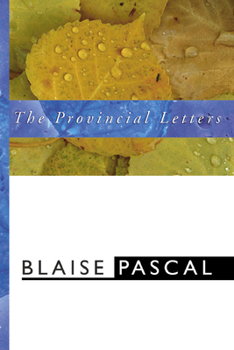
The Provincial Letters

Select Format
Select Condition 
Book Overview
The Provincial letters are a series of eighteen letters written by French philosopher and theologian Blaise Pascal. Written in the midst of the formulary controversy between the Jansenists and the Jesuits, they are a defense of the Jansenist Antoine Arnauld from Port-Royal-des-Champs, a friend of Pascal who in 1656 was condemned by the Facult? de Th?ologie at the Sorbonne in Paris for views that were claimed to be heretical. The First letter is dated January 23, 1656 and the Eighteenth March 24, 1657. A fragmentary Nineteenth letter is frequently included with the other eighteen. In these letters, Pascal humorously attacked casuistry, a rhetorical method often used by Jesuit theologians, and accused Jesuits of moral laxity. Being quickly forced underground while writing the Provincial Letters, Pascal pretended they were reports from a Parisian to a friend in the provinces, on the moral and theological issues then exciting the intellectual and religious circles in the capital. In the letters, Pascal's tone combines the fervor of a convert with the wit and polish of a man of the world. Their style meant that, quite apart from their religious influence, the Provincial Letters were popular as a literary work. Adding to that popularity was Pascal's use of humor, mockery, and satire in his arguments. The letters also influenced the prose of later French writers like Voltaire and Jean-Jacques Rousseau. Brilliantly written by Pascal, the Provincial Letters would not have been possible without the work of theologians from Port-Royal; indeed, most of the arguments Pascal deployed were already to be found in Arnauld's Th?ologie morale des J?suites, something which led the Jesuit Nicolas Caussin to reply to Pascal's perceived libel. Pascal's main source on Jesuit casuistry was Antonio Escobar's Summula casuum conscientiae (1627), several propositions of which would be later condemned by Pope Innocent XI. Paradoxically, the Provincial Letters were both a success and a defeat: a defeat, on the political and theological level, and a success on the moral level. Thus, King Louis XIV ordered that the book be shredded and burnt in 1660. The final letter from Pascal, in 1657, had defied the Pope himself, provoking Alexander VII to condemn the letters. But that didn't stop most of educated France from reading them. Moreover, even Pope Alexander, while publicly opposing them, nonetheless was persuaded by Pascal's arguments. Just a few years later, Alexander condemned "laxity" in the church and ordered a revision of casuistical texts.
Format:Paperback
Language:English
ISBN:1579100961
ISBN13:9781579100964
Release Date:December 1997
Publisher:Wipf & Stock Publishers
Length:210 Pages
Weight:0.70 lbs.
Dimensions:0.5" x 6.1" x 9.0"
Customer Reviews
1 rating
Excellent Read; Humorous and Insightful
Published by Thriftbooks.com User , 25 years ago
This series of letters by Blaise Pascal has it all; humor, a good guy (Pascal) and bad guys (Jesuits), and a moral.Pascal wrote these letters in defense of his Jansenist friends who were being branded as heretics by the Jesuits. At the time, the Jesuits were a powerful religious order who basically taught Christianity all over the world. In the Provincial Letters, Pascal exposes and ridicules the doctrines of the Jesuits, especially the "doctrine of probable opinions". The Jesuits (supposedly) were attempting to update the Christian doctrine to satisfy the lax morals of the modern world. In an attempt to "widen the pipe" to heaven, the Jesuits developed "modern" church doctrine (while ignoring traditional church doctrine, and the scriptures) to compensate for societies lax morals. Pascal, defender of the faith, effectively ridicules their doctrines and shows their errors.A word of caution, the letters are difficult going with respect to discussions on the finer theological points of view (how far we have fallen regarding knowledge of our faith). A good introduction will orient the reader to the conflicts and provide information regarding many of the theological discussions (the edition I used did not have an introduction; this one may). However, Pascal's writing is so humorous and engaging that I continued reading even when I was lost in the argument.I am on record (in another review) as stating that religion should be updated to reflect our modern view of the world. However, these letters point out the danger of attempting to do that. I need to reconsider that approach.
Copyright © 2026 Thriftbooks.com
Terms of Use | Privacy Policy | Do Not Sell/Share My Personal Information | Cookie Policy | Cookie Preferences | Accessibility Statement
ThriftBooks ® and the ThriftBooks ® logo are registered trademarks of Thrift Books Global, LLC
ThriftBooks ® and the ThriftBooks ® logo are registered trademarks of Thrift Books Global, LLC
