


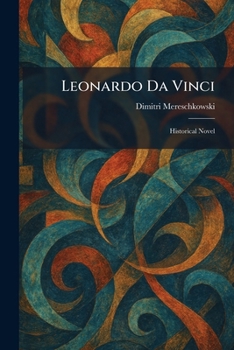
Leonardo Da Vinci: Historical Novel

"Leonardo Da Vinci (Historical Novel)" is a sweeping portrayal of one of history's most enigmatic and brilliant figures. Set against the vibrant yet turbulent backdrop of the Italian Renaissance, the narrative delves into the complex life of the ultimate polymath. Dimitri Mereschkowski masterfully recreates the world of 15th-century Italy, following Leonardo as he navigates the courts of Milan and Florence, juggling his monumental artistic commissions with his insatiable scientific curiosity.
The novel explores the profound internal and external conflicts of a man who stands at the crossroads of faith and reason. Through rich prose, the book captures the essence of the "Renaissance Man," illustrating his struggles with perfectionism, his relationships with rival figures, and his tireless pursuit of universal knowledge. It is not merely a biographical account but a philosophical examination of the dualities of human nature-the struggle between the divine and the secular, the creative and the destructive.
This work stands as a cornerstone of historical fiction, offering readers an immersive look at the intellectual fervor and the artistic splendor of the era. Mereschkowski's evocative storytelling brings the creation of legendary masterpieces to life, making it a compelling read for those interested in art, philosophy, and the life of a true genius.
This work has been selected by scholars as being culturally important, and is part of the knowledge base of civilization as we know it. This work was reproduced from the original artifact, and remains as true to the original work as possible. Therefore, you may see the original copyright references, library stamps (as most of these works have been housed in our most important libraries around the world), and other notations in the work.
This work is in the public domain in the United States of America, and possibly other nations. Within the United States, you may freely copy and distribute this work, as no entity (individual or corporate) has a copyright on the body of the work.
As a reproduction of a historical artifact, this work may contain missing or blurred pages, poor pictures, errant marks, etc. Scholars believe, and we concur, that this work is important enough to be preserved, reproduced, and made generally available to the public. We appreciate your support of the preservation process, and thank you for being an important part of keeping this knowledge alive and relevant.
Customer Reviews
ThriftBooks ® and the ThriftBooks ® logo are registered trademarks of Thrift Books Global, LLC
