


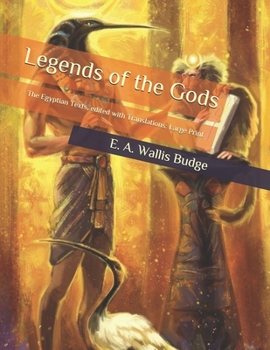
Legends of the Gods: The Egyptian Texts, edited with Translations: Large Print

The text of the remarkable Legend of the Creation which forms the first section of this volume is preserved in a well-written papyrus in the British Museum, where it bears the number 10,188. This papyrus was acquired by the late Mr. A. H. Rhind in 1861 or 1862, when he was excavating some tombs on the west bank of the Nile at Thebes. He did not himself find it in a tomb, but he received it from the British Consul at Luxor, Mustafa Agha, during an interchange of gifts when Mr. Rhind was leaving the country. Mustafa Agha obtained the papyrus from the famous hiding-place of the Royal Mummies at Der-al-Bahari, with the situation of which he was well acquainted for many years before it became known to the Egyptian Service of Antiquities. When Mr. Rhind came to England, the results of his excavations were examined by Dr. Birch, who, recognising the great value of the papyrus, arranged to publish it in a companion volume to Facsimiles of Two Papyri, but the death of Mr. Rhind in 1865 caused the project to fall through. Mr. Rhind's collection passed into the hands of Mr. David Bremner, and the papyrus, together with many other antiquities, was purchased by the Trustees of the British Museum. In 1880 Dr. Birch suggested the publication of the papyrus to Dr. Pleyte, the Director of the Egyptian Museum at Leyden. This savant transcribed and translated some passages from the Festival Songs of Isis and Nephthys, which is the first text in it, and these he published in Recueil de Travaux, Paris, tom. iii., pp. 57-64. In 1886 by Dr. Birch's kindness I was allowed to work at the papyrus, and I published transcripts of some important passages and the account of the Creation in the Proceedings of the Society of Biblical Archaeology, 1886-7, pp. 11-26. The Legend of the Creation was considered by Dr. H. Brugsch to be of considerable value for the study of the Egyptian Religion, and encouraged by him FN#1] I made a full transcript of the papyrus, which was published in Archaeologia, (vol. lii., London, 1891), with transliterations and translations. In 1910 I edited for the Trustees of the British Museum the complete hieratic text with a revised translation. FN#2] FN#1] Ein in moglichst wortgetreuer Uebersetzung vorglegter Papyrus- text soll den Schlussstein meines Werkes bilden. Er wird den Beweis fur die Richtigkeit meiner eigenen Untersuchungen vollenden, indem er das wichtigste Zeugniss altagyptischen Ursprungs den zahlreichen, von mir angezogenen Stellen aus den Inschriften hinzufugt. Trotz mancher Schwierigkeit im Einzelnen ist der Gesammtinhalt des Textes, den zuerst ein englischer Gelehrter der Wissenschaft zuganglich gemacht hat, such nicht im geringsten misszuverstehen (Brugsch, Religion, p. 740). He gives a German translation of the Creation Legend on pp. 740, 741, and a transliteration on p. 756. FN#2] Egyptian Hieratic Papyri in the British Museum, London, 1910, folio.
Format:Paperback
Language:English
ISBN:B08BWGPSJ2
ISBN13:9798658818559
Release Date:June 2020
Publisher:Independently Published
Length:154 Pages
Weight:0.82 lbs.
Dimensions:0.3" x 8.5" x 11.0"
Related Subjects
HistoryCustomer Reviews
1 rating
Understand the Egyptian pantheon and some spiffy spells!
Published by bernie4444 , 3 months ago
People can learn the names of the gods and what they are best known for. Like the Edda tells the tales of the Norse gods, this presents some key papyrus and other sources that tell the tales of the Egyptian gods and their personalities.
We learn of amulets, spells, and histories of the gods and their people.
There are other sources, but this one is unique in organizing the different tears of gods and their relation to each other.
-----------------
Now we have a problem with mixed versions. The hard copy has great sketches of the papyri and cartouches. Still, it is missing some simple, helpful graphs like “The Great Ennead of Heliopolis” and some comparison of Upper Egypt and Lower Egypt.
Because they are mixed versions, the star rating is for the book in general
Copyright © 2026 Thriftbooks.com Terms of Use
| Privacy Policy | Do Not
Sell/Share My Personal Information | Cookie Policy | Cookie Preferences | Accessibility Statement
ThriftBooks® and the ThriftBooks® logo are registered trademarks of Thrift Books Global, LLC
ThriftBooks® and the ThriftBooks® logo are registered trademarks of Thrift Books Global, LLC
