


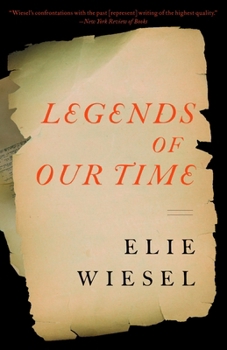
Legends of Our Time


Select Format
Select Condition 
Book Overview
As a child in Sighet, as a young boy in Auschwitz, as a teenage displaced person wandering through post-World War II Europe, as a young man at the beginning of his career as a writer, witness, and human-rights activist, Elie Wiesel had haunting, often surreal encounters with a wide range of people--sages, mystics, teachers, and dreamers. In Legends of Our Time, he shares with us some of their stories. On a Tel Aviv bus, Wiesel encounters a notorious Auschwitz barracks chief who forces him to confront past demons that he thought had long since been laid to rest. While traveling through Spain, he is approached by a young Catholic man holding an ancient family document in an unfamiliar language; written in Hebrew in 1492 by the man's Marrano ancestor, it proudly proclaims to future generations the family's Jewish origins. Twenty years after being deported from Sighet, Wiesel returns to discover that the only thing missing are the towns 10,000 Jews and the collective memory of their ever having existed. In a Moscow synagogue in the fall on 1967, Wiesel finds a sanctuary filled with young Jews who have miraculously educated themselves in their history and ancient language, who sing Hebrew songs in the street as KGB agents take down names. And from a rabbi in Auschwitz who fasted on Yom Kippur, Wiesel leans that there is more than one way to confront a God who seems to have abandoned His people.
Format:Paperback
Language:English
ISBN:0805211756
ISBN13:9780805211757
Release Date:April 2004
Publisher:Schocken Books Inc
Length:208 Pages
Weight:0.80 lbs.
Dimensions:0.7" x 5.2" x 8.0"
Customer Reviews
2 ratings
Legends of Our Time
Published by Thriftbooks.com User , 16 years ago
Eli Wiesel returns to Sighet in Romania where he was born to walk the streets of his hometown. He notes that "Nothing had changed. The house was the same, the street was the same, the only thing missing were the Jews! Truly one of his great works as a writer and story teller. This book is a must to read. I could not put it down and read it all night.
Israel is Oppressed
Published by Thriftbooks.com User , 22 years ago
I loved this book. As much as I would like to understand how the Shoah happened, as a Christian, after reading Wiesel, I have to respond to the psalmist's command "and all wickedness shuts its mouth. Psalm 107:42." Most of Wiesel's books are fiction, but in this one, he is the main character. The book is thoughtful and thought provoking. My copy was given me by a jewish friend whom I had to convince I wanted to keep it; she wanted to keep it too! (I normally return borrowed books).Haunting when Wiesel returns to Sighet in Romania to walk the streets of his hometown. He reflected "Nothing had changed. The house was the same, the street was the same, the world was the same, God was the same. Only the jews had disappeared." Can you imagine anything like that?If it is any consolation, and I hope Mr. Wiesel is not offended, "behold, the Lord hath proclaimed unto the end of the world, Say ye to the daughter of Zion, behold your salvation comes, and his recompense with Him. Isaiah 62:11" And, from Isaiah 61:8 "the Lord loves justice, He hates robbery and wrong." And from Isaiah 25:8 "and the Lord God will wipe away all tears from their eyes, and will swallow up death in victory."And if Christians do not see the writing on the wall and see our own guilt in what transpired in this last century, and at least respond with knocking knees, as Belshazzar, the Babylonian king, did, then Christianity is in deep trouble. But those are my own reflections not Wiesel's. He states in this book "That is what I reproach us for: our boundless arrogance in thinking we know everything." And "I repeat: hatred is no solution."
Copyright © 2026 Thriftbooks.com Terms of Use
| Privacy Policy | Do Not
Sell/Share My Personal Information | Cookie Policy | Cookie Preferences | Accessibility Statement
ThriftBooks® and the ThriftBooks® logo are registered trademarks of Thrift Books Global, LLC
ThriftBooks® and the ThriftBooks® logo are registered trademarks of Thrift Books Global, LLC
