


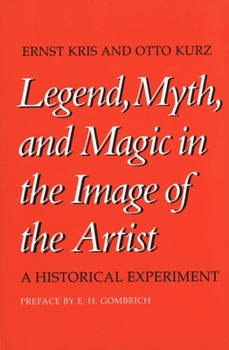
Legend, Myth, and Magic in the Image of the Artist: A Historical Experiment

"This is the first English translation of a brief, scholarly, and brilliantly original work which sets out to examine the links between the legend of the artist, in all cultures, and what E.H. Gombrich, in an introductory essay, calls 'certain invariant traits of the human psyche.'"--Denis Thomas, Journal of the Royal Society of Arts
"This book gathers together various legends and attitudes about artists, ancient and modern, East and West, and gives fascinating insights into attitudes toward artistic creation. It impinges on psychology, art history and history, aesthetics, biography, myth and magic, and will be of great interest to a wide audience in many fields.... A delightful and unrivalled study."--Howard Hibbard
"Thought provoking and valuable.... To all those interested in psychiatry and art from the perspectives of history, criticism, or therapy and to the wide audience concerned with the psychology of aesthetics and of artistic creation."--Albert Rothenberg, American Journal of Psychiatry
Ernst Kris was a psychoanalyst who wrote on a wide variety of subjects, including art. Otto Kurz was librarian of the Warburg Institute in London.
"This book gathers together various legends and attitudes about artists, ancient and modern, East and West, and gives fascinating insights into attitudes toward artistic creation. It impinges on psychology, art history and history, aesthetics, biography, myth and magic, and will be of great interest to a wide audience in many fields.... A delightful and unrivalled study."--Howard Hibbard
"Thought provoking and valuable.... To all those interested in psychiatry and art from the perspectives of history, criticism, or therapy and to the wide audience concerned with the psychology of aesthetics and of artistic creation."--Albert Rothenberg, American Journal of Psychiatry
Ernst Kris was a psychoanalyst who wrote on a wide variety of subjects, including art. Otto Kurz was librarian of the Warburg Institute in London.
Format:Paperback
Language:English
ISBN:0300026692
ISBN13:9780300026696
Release Date:September 1981
Publisher:Yale University Press
Length:176 Pages
Weight:0.79 lbs.
Dimensions:0.5" x 5.5" x 8.3"
Customer Reviews
1 rating
This is an unsurpassed classic!
Published by Thriftbooks.com User , 18 years ago
which is why it remains in print, despite the fact that it is a modest paperback with no illustrations whatsoever (almost unheard-of for an art book). The text (originally, a German-language contribution) was written by two very young scholars whose bold thesis is in many ways representative of the brilliant inquiries of modernist thinkers between the two World Wars (when a whole generation of Western intellectuals--including the highly articulate proponents of Surrealism--had fully absorbed the ground-breaking psychological researches of Freud and Jung). Kris and Kurz's thesis is that our modern ideas about what makes artists tick (inspiration, genius, eccentricity, neurosis or even madness, technical wizardry, etc.) have a very ancient and widespread ancestry. They correspond, to a greater or lesser extent, to a transcultural, and composite "artist type" (the different elements do not form a seamless whole, but arise from diverse and overlapping traditional understandings of the skills required for art-making) whose features can be found--as the title suggests--in ancient mythic and legendary material, and can be traced into the documented history of art, down to our own day. Rather than claiming outright that the "image" of The Artist is an archetype reembodied in every authentic flesh-and-blood artist, Kris and Kurz leave us with the more interesting possibility that individual artists, whether trained in a tradition that exalts personal talent, or one that rewards collaborative effort (and likewise the far more numerous viewers of their art), all inherit the composite "artist-template" and are molded by it in one way of another, according to the specific expectations of their particular social world. The authors cite a wealth of anecdotal material surviving in ancient European and Asian literary sources, establish its connections with Early Modern artistic biography, and also draw on anthropological material then becoming available to them. The book is not an "easy read," but it is concise and to the point (the opening chapter lays out all of the main arguments and rewards careful reading), and filled with marvelous examples of the special roles artists are, even now, called upon to play.
Copyright © 2026 Thriftbooks.com Terms of Use
| Privacy Policy | Do Not
Sell/Share My Personal Information | Cookie Policy | Cookie Preferences | Accessibility Statement
ThriftBooks® and the ThriftBooks® logo are registered trademarks of Thrift Books Global, LLC
ThriftBooks® and the ThriftBooks® logo are registered trademarks of Thrift Books Global, LLC
