


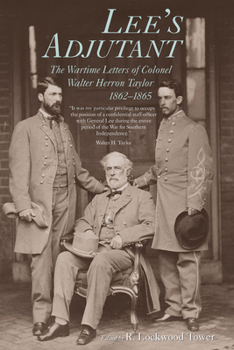
Lee's Adjutant: The Wartime Letters of Colonel Walter Herron Taylor, 1862-1865


Select Format
Select Condition 
Book Overview
Of all those who served with Robert E. Lee in the headquarters of the Army of Northern Virginia, no one was as close to him as Walter Taylor. Twenty-two years old when hostilities broke out, Taylor served at Lee's side virtually without interruption during the entire Civil War. The only officer who could lay claim to such a distinction, Taylor served first as aide-de-camp and subsequently as assistant adjutant general of the Army of Northern Virginia. Taylor traveled with Lee, ate at his mess, shielded him from a flood of administrative concerns, and on occasion delivered his battlefield orders. Taylor's personal correspondence, written without reserve as he enjoyed an unparalleled opportunity to observe Lee and his inner circle, constitutes a unique addition to the Civil War record. The 110 letters compiled in Lee's Adjutant shed light on day-to-day life at Lee's headquarters and on the general himself. Written to Taylor's fianc e and family, the recount the Army of Northern Virginia's early triumphs, invasions of the North, defeat at Gettysburg, and final surrender. To these revealing letters, R. Lockwood Tower adds a biographical sketch of the young adjutant that describes his role in helping Lee organize the Army of Virginia and-as an officer who lived to see the fiftieth anniversary of the war's end-in shaping Confederate memory.
Format:Hardcover
Language:English
ISBN:1570030219
ISBN13:9781570030215
Release Date:March 1995
Publisher:University of South Carolina Press
Length:350 Pages
Weight:1.74 lbs.
Dimensions:1.3" x 6.3" x 9.3"
Customer Reviews
1 rating
Solid but Suprisingly Unrevealing Collection of Letters
Published by Thriftbooks.com User , 16 years ago
"Lee's Adjutant" holds an odd place in the increasing number of books on Robert E. Lee. These are the letters of Col. Walter H. Taylor, Lee's chief staff officer during the war. Editor R. Lockwood Tower opens the book with an excellent sketch of Taylor's life and his role in the Army of Northern Virginia. The letters, while often interesting, really do not reveal that much about Lee during the war though there are occasional scenes that stick with the reader: Lee loses his temper at Taylor, the general's reaction to the death of his daughter Annie in 1862, Lee's bemused puzzlement that Taylor wants to rush into Richmond to marry his fiance just as Grant is about to take the city. Nor are Taylor's letters helpful on some of the more dramatic moments of the war. For example, they are skimpy on Gettysburg (and Taylor's role on July 1 in issuing orders to Richard Ewell) and Taylor, to his later regret, made an excuse so he would not be present when Lee surrendered at Appomattox. What Taylor does reveal in these letters are his duties as Lee's primary staff officer. Having said that, the best part of the book remains the introduction by Tower, an odd thing to say about a collection of primary sources with as much historical value as Taylor's letters.
Copyright © 2026 Thriftbooks.com Terms of Use
| Privacy Policy | Do Not
Sell/Share My Personal Information | Cookie Policy | Cookie Preferences | Accessibility Statement
ThriftBooks® and the ThriftBooks® logo are registered trademarks of Thrift Books Global, LLC
ThriftBooks® and the ThriftBooks® logo are registered trademarks of Thrift Books Global, LLC
