


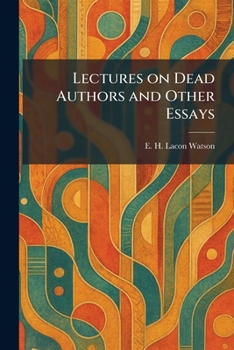
Lectures on Dead Authors and Other Essays

"Lectures on Dead Authors and Other Essays" is an engaging and witty collection of literary reflections by E. H. Lacon Watson. In this series of thoughtfully crafted essays, the author explores the enduring legacy of classic writers and the ever-shifting tides of literary reputation. Watson, known for his keen observation and gentle humor, provides a series of "lectures" that are less formal academic exercises and more intimate conversations about the books and authors who have shaped the English canon.
The volume covers a diverse array of topics, from the trials of the writing life to the eccentricities of book collecting and the specific charms of authors long since passed. Watson's prose is characterized by its elegance and accessibility, making it an excellent resource for anyone interested in the history of English literature or the art of the personal essay. His insights into the "dead authors" of the title serve as a bridge between the Victorian era and the modern age, offering contemporary readers a unique perspective on how great works were perceived in the early twentieth century.
This collection stands as a testament to the timeless value of literary criticism that prioritizes passion and personality. "Lectures on Dead Authors and Other Essays" is a must-read for bibliophiles, students of literature, and those who find joy in the quiet contemplation of the written word.
This work has been selected by scholars as being culturally important, and is part of the knowledge base of civilization as we know it. This work was reproduced from the original artifact, and remains as true to the original work as possible. Therefore, you may see the original copyright references, library stamps (as most of these works have been housed in our most important libraries around the world), and other notations in the work.
This work is in the public domain in the United States of America, and possibly other nations. Within the United States, you may freely copy and distribute this work, as no entity (individual or corporate) has a copyright on the body of the work.
As a reproduction of a historical artifact, this work may contain missing or blurred pages, poor pictures, errant marks, etc. Scholars believe, and we concur, that this work is important enough to be preserved, reproduced, and made generally available to the public. We appreciate your support of the preservation process, and thank you for being an important part of keeping this knowledge alive and relevant.
Customer Reviews
ThriftBooks ® and the ThriftBooks ® logo are registered trademarks of Thrift Books Global, LLC
