


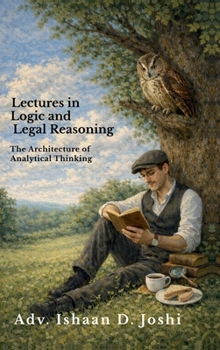
Lectures in Logic and Legal Reasoning: The Architecture of Analytical Thinking

Lectures in Logic and Legal Reasoning approaches logic not as abstract philosophy, but as the working machinery of law and investigation. From analysing witness statements and testing forensic inferences to applying statutory elements and dismantling weak arguments, this book shows how conclusions are built, challenged, and defended under real legal pressure. It moves through deduction, induction, relevance, burden of proof, causal reasoning, syllogism, and linguistic precision with one practical aim: to train the reader to distinguish evidence from assertion and probability from proof. For law students, investigators, advocates, and anyone engaged in legal decision-making, it offers a disciplined framework for constructing arguments that can withstand cross-examination, judicial scrutiny, and institutional doubt.
Customer Reviews
ThriftBooks ® and the ThriftBooks ® logo are registered trademarks of Thrift Books Global, LLC
