


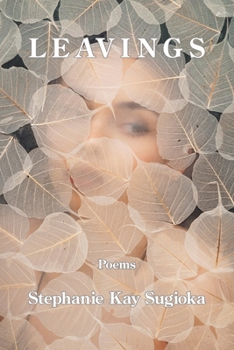
Leavings

Like a richly modulated solo, the living voice of Stephanie Sugioka's Leavings rises from and accompanies the years, sharing the seasons of a lifetime: "The trees with infinite grace / gave up their leaves / and we wallowed in their wealth." Given her unerring ear, her loving eye, her unsparing candor, she might, in describing her aunt, be imaging her own poetics, "poised / as a lotus on a long cool stem / And down her spine there runs / a fine thread of Samurai steel."
-Eleanor Wilner, Chancellor of the Academy of American Poets and author, Before Our Eyes: New and Selected Poems 1975-2017
Through the words of Leavings, Stephanie Sugioka's exquisite new poetry collection, the Japanese kaze - a wind of both nature and spirit - circles and sweeps, storms and whispers through her words. "For a woman's soul is like wind," she writes in "After Reading The Tale of Genji." From her shattered childhood family in "Dismembered," where "in the high silver light / the angels are still screaming," to holding her husband, Jeffrey, diagnosed with terminal brain cancer, when she feels "a tremor / deep in his] body / that told me it was shutting down," Sugioka pens her bitter sorrow in images of frozen earth, hollows, and husks. And yet, in the effortless quality of poems that seem lifted by wind and carried not only to the darkest depths but to the ascendant music of birds and blossoms, rivers and trees, we see a luminous poet with formidable intelligence and strength. Of her daughter, she writes, "When the whole world goes gray / I take out Sarah's art." Of Aaron, her son, she writes, "When they laid him] in my arms . . . his dark, enormous eyes / devouring my face . . . I knew I was playing for keeps." I adore these poems. In one of the last, "Father of Waters," addressed to Walt Whitman, she imagines "the wind your endless voice / calling, so softly, / come home."
-Suzanne Underwood Rhodes, Arkansas Poet Laureate and author, The Perfume of Pain
Related Subjects
PoetryCustomer Reviews
ThriftBooks ® and the ThriftBooks ® logo are registered trademarks of Thrift Books Global, LLC
