
Skip to content
Scan a barcode
Scan
Paperback Leaving Birmingham: Notes of a Native Son Book

ISBN: 0817310223

ISBN13: 9780817310226

Leaving Birmingham: Notes of a Native Son

Select Format

Select Condition ThriftBooks Help Icon

Recommended

Format: Paperback

Condition: Very Good

$41.69
Almost Gone, Only 1 Left!
Save to List

Book Overview

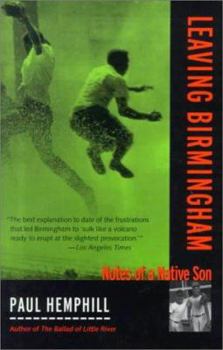
P>Birmingham's history of racial violence and bigotry is the centerpiece of this intense and affecting memoir about family, society, and politics in a city still haunted by its notorious past.

In 1963, Birmingham was the scene of some of the worst racial violence of the civil rights era. Police commissioner "Bull" Connor loosed dogs and turned fire hoses on black demonstrators; four young girls at Sunday school were killed when a bomb exploded in a black church; and Martin Luther King, Jr., wrote his famous letter from the Birmingham jail, defending his activism to fellow ministers.

Birmingham native Paul Hemphill, disillusioned with his hometown, had left home to pursue a journalistic career, so he witnessed these historic events with the rest of the world through newspaper and television reports. "That grim old steel town," he writes, "was the most blatantly segregated city of its size in the United States of America, and most of us regarded it with the same morbid fascination that causes us to slow down and gawk at a bloody wreck on the highway."

Thirty years later, Hemphill returned to Birmingham to explore the depths of change that had taken place in the decades since the violence. In this powerful memoir, he interweaves his own autobiography with the history of the city and the stories of two very different Birmingham residents: a wealthy white matron and the pastor of the city's largest black church. As he struggles to come to terms with his own conflicting feelings toward his father's attitudes, Hemphill finds ironic justice in the integration of his childhood neighborhood and a visit with the black family who moved into his family's former home.

Customer Reviews

5 ratings

Great read, especially if you grew up in Birmingham during the same period.

I grew up in Birmingham and remember many of the same experiences, so it was like talking (or listening) to an old friend.

Review for "Leaving Birmingham"

I had a reason and desire to read this book because I grew up in Birmingham, lived in the same neighborhood vicinity as the author, and graduated from the same high school as the author. Mr. Hemphill was a good writer, especially since he essentially taught himself to be a writer, and his perspective and history of Birmingham in the years leading up to the pivotal sixties is well done. At times I felt like I was still back home in my backyard in Woodlawn as I read the book and remembered the same streets, places and people that he describes there. Mr. Hemphill's chapter that outlines the history and foundation of Birmingham and the explanations for the behaviors and events that followed are as good as anything I have yet read about the city, and that includes Diane McWhorter's prize winning book about her home town of Birmingham, "Carry Me Home", published a few years ago. But, Ms. McWhorter grew up "over the mountain" and not "down in the valley" as I did and Mr. Hemphill did so his perspective is much more real and personalfor me, as good as her book was and is. If you are a native of Birmingham, "Leaving Birmingham" is a must read. And even if you are not a native, it is compelling for those who enjoy and appreciate a good history and a good autobiography as well.

Great Perspective of the South during a Tumultous Time

I decided to read this book for purely personal motives. Having been raised in California by a father who grew up in Birmingham in the early twenties and thirties, I had a desire to understand this man, my father, who seemed at times to have such radical world views. Reading Paul Hemphill's story, specifically the retelling of details of growing up in a working class family, including the bigoted views his father held, helped me to understand the world that molded many whites prior to the civil rights movement. When chosing this book, I wasn't looking for a dry detailed history but rather an insiders view of what this world of "Birmingham, Alabama" must have been like growing up. Why it created such biogtry? And How can we continue to change? Paul Hemphill, through this book, helped me to understand, what kind of a world Birmingham was, and how it shaped and molded the people who grew up there.

A Student's Perspective

This book was required reading for my Civil Rights class. Although at times a bit too detailed and tangent prone, Hemphill's style is very gripping and kept my attention. The way in which the formation and development of Birmingham is disussed, enterpreted, and explained is superb. Hemphill does an excellent job of juxtaposing the racial, economic, and social climate that evolved and gripped the city of Birmingham throughout the years. I would consider this autobiography of sorts a must read for any person interested in issues pertaining to the Civil Rights Movement. Just get through the few dry parts, the rest is well worth the read!

Probes the ethnic relationships in Birmingham

In 1963 Alabama was the site of racial violence: native Hemphill decides here to return to his hometown, to come to terms with his family and life. Leaving Birmingham probes the ethnic relationships in Birmingham past and present, providing an intriguing analysis of the tensions and present-day life.
Copyright © 2026 Thriftbooks.com Terms of Use | Privacy Policy | Do Not Sell/Share My Personal Information | Cookie Policy | Cookie Preferences | Accessibility Statement
ThriftBooks ® and the ThriftBooks ® logo are registered trademarks of Thrift Books Global, LLC

GoDaddy Verified and Secured
