


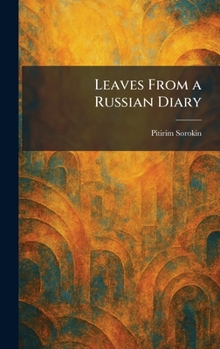
Leaves From a Russian Diary

"Leaves From a Russian Diary" is a gripping first-hand account of the tumultuous years surrounding the Russian Revolution, penned by the renowned sociologist Pitirim Sorokin. As a witness to the seismic shifts in Russian society, Sorokin provides a uniquely detailed and personal perspective on the collapse of the Tsarist empire and the subsequent rise of the Bolshevik regime.
The narrative captures the chaos, violence, and profound social transformation of the period between 1917 and 1922. Sorokin describes his experiences navigating a landscape of political instability, including his time in hiding and his eventual imprisonment. Beyond a mere historical record, the work serves as a profound sociological observation of a nation in the throes of radical change, exploring the human cost of ideological struggle and the fragility of social order.
This memoir remains an essential resource for those seeking to understand the internal realities of the Russian Revolution. Sorokin's sharp observations and harrowing personal journey offer invaluable insights into one of the most significant political upheavals of the twentieth century, making "Leaves From a Russian Diary" a landmark text in both historical and autobiographical literature.
This work has been selected by scholars as being culturally important, and is part of the knowledge base of civilization as we know it. This work was reproduced from the original artifact, and remains as true to the original work as possible. Therefore, you may see the original copyright references, library stamps (as most of these works have been housed in our most important libraries around the world), and other notations in the work.
This work is in the public domain in the United States of America, and possibly other nations. Within the United States, you may freely copy and distribute this work, as no entity (individual or corporate) has a copyright on the body of the work.
As a reproduction of a historical artifact, this work may contain missing or blurred pages, poor pictures, errant marks, etc. Scholars believe, and we concur, that this work is important enough to be preserved, reproduced, and made generally available to the public. We appreciate your support of the preservation process, and thank you for being an important part of keeping this knowledge alive and relevant.
Customer Reviews
ThriftBooks ® and the ThriftBooks ® logo are registered trademarks of Thrift Books Global, LLC
