


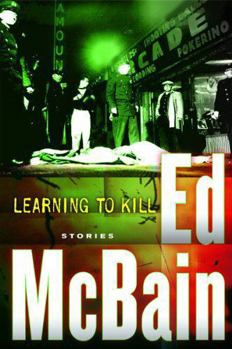
Learning to Kill: Stories


Select Format
Select Condition 
Book Overview
Ed McBain made his debut in 1956. In 2004, more than a hundred books later, he personally collected twenty-five of his stories written before that time. All but five of them were first published in... This description may be from another edition of this product.
Format:Hardcover
Language:English
ISBN:0151012229
ISBN13:9780151012220
Release Date:July 2006
Publisher:Houghton Mifflin Harcourt
Length:496 Pages
Weight:1.64 lbs.
Dimensions:9.8" x 1.5" x 6.8"
Customer Reviews
5 ratings
Tales of Private Eyes, Cops, Gangs, and the Mean Streets
Published by Thriftbooks.com User , 16 years ago
The collection Learning to Kill offers a selection of Ed McBain's short stories, all published in the period 1952-1957, the years that saw the launch of his literary career; as the jacket notes proclaim, between the book's covers are to be found stories written by Ed McBain before he was Ed McBain, stories that first appeared under either his legally adopted name of Evan Hunter or a variety of noms-de- plumes. Granted that the selected stories are representative of Mr McBain early work they afford the reader a chance to look over his shoulder as he masters his craft. Most of the stories in this collection first saw publication in Manhunt, one of the last of the pulp magazines (the pulps, alas, were a dying breed by the time Mr McBain began his writing career in the early 1950's); many were written while the author earned his living working for a literary agency as a reader of unsolicited manuscripts (In an author's introduction he credits his stint of employment at this agency for providing him with an entry into the publishing world, opening the way for his own career). The stories collected in Learning to Kill are arranged, according to their thematic content, into separate sections, under headings such as "Private Eyes", "Cops and Robbers", "Innocent Bystanders", and "Gangs". Among the most memorable stories in the collection are those gathered under the headings "Kids" and "Gangs", affecting tales of youths who, though barely in their teens, are already trapped by the mean streets into lives of crime from which there is no real hope of escape. Two stories in this vein are especially noteworthy, "On the Sidewalk, Bleeding" and "The Last Spin", a pair of stories about youngsters who lose their lives to the violence engendered by the pointless rivalries and turf wars of neighborhood street gangs. In "On the Sidewalk, Bleeding" a sixteen year old boy belonging to a street gang lies in the shadowed recesses of an alleyway, hidden from the view of passers by, rain drenched and mortally wounded; ambushed and stabbed by a member of a rival gang, he has been left to die on the cold pavement, alone. Sensing it ebbing away from him, he grieves the loss of a life he has been robbed of the chance to live, a life casually stolen from him by someone who knew (and cared for) nothing about him other than his gang affiliation In the poignant "The Last Spin" two boys belonging to rival gangs form all too brief a friendship in the short time it takes for the pair of them to play out a deadly game of Russian Roulette (a game set up to settle a turf war in a 'civilized' fashion); the youths, who otherwise could have met only as enemies, discover a greater affinity for one another than either one ever felt for the confraternity of his gang . To judge from the stories gathered under the heading "Private Eyes", I have the sense that Mr McBain couldn't really put his heart in
The Making of a Grandmaster
Published by Thriftbooks.com User , 17 years ago
This isn't really Learning to Kill but really Learning to Become a Professional Writing-101. Salvatore Lombino, aka Evan Hunter, aka Richard Marsten, and aka- freakin' finally, Ed McBain, was a Grandmaster of the Mystery genre and in this collection of his earliest short stories we get a wonderful introduction and personal glimpse at how it all began. You don't just become a great writer; it is an evolutionary process and long before you learn how to walk upright you first have to crawl out of the primordial prose and go from grunting to articulation. That's what you get here; McBane's writing origins and genetic credential check. With these early pulp magazine stories we see the DNA forming, the synapses firing, the links coming together that over time produced a great mystery and police procedural writer. Are some of the stories in this book out-dated? Sure. They were written in the 50s but they still read well. Better yet, you get McBane's comments on how they came to into being. This book offers a great introduction into writing and the writing business, from no experience and a wall plastered with rejection slips to pulp magazine acceptance and a life-long career. Is this book for the modern reader? Probably not but it is for the serious modern writer. You're missed Sal, Evan, Richard and Ed. You truly are.
Mastering the Craft of Crime: How Ed McBain Learned to Kill
Published by Thriftbooks.com User , 19 years ago
Ed McBain was one of those writers who must have never slept. Writing under four separate pseudonyms, he produced more than a hundred novels in a span of less than fifty years. His contributions to crime fiction are legion. He is credited with being the creator and undisputed master of the police procedural novel, as exemplified by his 87th precinct series. His writing style was spare and effective. Only slightly wordier than Papa Hemingway, his work inspired numerous writers including Elmore Leonard and James Ellroy. His career began in the mid 1950s, almost by a fluke, when he responded to an ad for a low-paying copy editor position in New York City. The job fell into his lap, and pretty soon he found himself writing short stories, as well as checking facts and correcting typos. His stories resonated with the same tone that Raymond Chandler had perfected, and he was able to crank them out at will. They were gritty and pulpish, peopled with ruffians, lowlifes and cheap gumshoes. Set in the abandoned warehouses and run-down tenement neighborhoods of the lower west side, the material was drawn from McBain's own experiences as the son of first-generation Eastern European immigrants. Shortly before his death in 2005, the author sat down with his publishers at Harcourt and compiled this collection of early stories dating back to the 1950s. These writings represent his early attempts at crime fiction, hence the title of the collection. There are 25 stories here, every one written in his fast-paced and edgy style. The stories are divided into sections based on character types. There are tales about juvenile delinquents, femme fatales, private eyes, precinct detectives, innocent bystanders, the mentally imbalanced, gangsters and so on. The action moves quickly, and the dialogue is snappy and filled with countless ironies. In one story a young punk celebrates his first arrest, only to discover that he's accidentally killed his victim. In another, numerous passersby refuse to give aid to a stabbing victim because he's wearing a gang jacket. He must have had it coming, they figure. There are hardly any good guys here, at all. Sometimes the protagonist is only barely likeable, and that's only because he's not as bad as everyone else around him. These are not tales of good versus evil; they are stories about the pretty bad going up against the downright ugly. There's a kind of emptiness in them, too, a sadness about the depravity that sometimes obscures the human condition. These poor characters have resigned themselves to life on the streets, doing what they do because it's the only thing they know. McBain does not glorify crime, or even make it seem exciting. Instead, he reveals it as the ugly thing it is. The brutality here is mundane, the kind that police officers shrug off as inconsequential. "What does it matter if one more hoodlum ends up on a stretcher," one character asks? These are stories about muggings and knifings, gang brawls and the like.
"Pulp fiction" at it's best
Published by Thriftbooks.com User , 19 years ago
Long before Quentin Tarantino popularized the term, there once was a real world of "pulp fiction." For the first half of the 20th century, magazines printed on cheap "pulp" paper with names like Black Mask, Manhunt and Argosy thrilled readers with lurid covers and often equally lurid tales of crime and violence, among other illicit subjects. The pulps were what businessmen read to relax on trips and teenage boys read with flashlights late at night in their rooms. The pulps didn't pay much to writers, only pennies per word --- some things never change --- and most highbrow literary types considered these writers "hacks." Some were. But the best pulp writers created the modern American mystery novel, hard-boiled crime fiction and film noir. They became literary greats like Dashiell Hammett, Raymond Chandler, Jim Thompson and Ed McBain. McBain, best known as the author of the 87th Precinct police procedurals, died in July 2005. But one of his last works was to put together LEARNING TO KILL, an anthology of 25 short stories he wrote between 1952 and 1957. These stories give not only a glimpse into the long-lost world of the pulps, but also show the emergence of a great writer learning his craft. For anyone who has ever enjoyed an 87th Precinct novel, this is essential reading. The stories were carefully selected by McBain and organized into seven mystery genres. As an added bonus, McBain wrote an introduction to each story that, unfortunately for his millions of fans, will have to serve as a memoir. The stories and commentary make this book an enjoyable, entertaining read. Like in a great noir film, things were never quite what they seemed in the world of the pulps. For instance, when the stories in LEARNING TO KILL were originally published, Ed McBain was not credited as the author of any of them. They were written under two pen names and the name Evan Hunter, which in 1952 became the legal name of the fellow who grew up as Salvatore Lombino in East Harlem, New York. Indeed, we learn here that nom de plum McBain was not even created until 1956. About a decade ago, I interviewed McBain and asked him why he had so many names. He told me, "When I was writing for the pulps, I used a lot of different names because I wanted to sell as much as I could." From 1952 to 1953, he was making $40 a week working at the Scott Meredith Literary Agency. If a pulp wanted a 2,000-word western or mystery or science fiction story, and the agency didn't have anything like that written by a client, McBain would go home that night, write the story himself and put another name on it. For pennies a word, a writer had to be creative. In those days, before television killed the pulps and short stories in general, a writer could learn his craft in these magazines. And we see many examples of this in LEARNING TO KILL. McBain tells us early on that the collection "is about learning to write crime fiction." Twenty of these stories were printed in Manhunt, which McBain descr
The history of a great American crime author
Published by Thriftbooks.com User , 19 years ago
Just before his sad death last year, Ed McBain oversaw the compilation of twenty-five of his earliest stories. This collection, Learning to Kill, has just been published, and it's a wonderful look back at (so my wife says) one of the best crime writers ever. Yes, that's right. I've never read an Ed McBain book before, so I probably didn't get as much out of this book as true fans would have, but even I can see the seeds to what became a brilliant career in these stories. All of these stories were published between 1952 and 1957, and they run the gamut from private detectives (a genre he swiftly removed himself from because he felt that only cops should be investigating murders) to "loose cannons" to the general cops and robbers that eventually became his bread and butter. One thing I can definitely say about this book is that it has increased my desire to read some of his 87th Precinct novels. Learning to Kill starts out with a wonderful introduction, where McBain details the history of his start in the writing business: responding to a blind ad in the New York Times for an editor that turned out to be from a literary agency. He almost turned it down when he discovered it was an agency, but quickly changed his mind when he found out why the person he was replacing was leaving. It turns out that he was making too much money writing his own stories to make staying in that position worth it. McBain jumped at the chance, and the rest is history. Once he was established, he began submitting his own work as well as handling other clients, and many of these stories are published in this book. The book is appropriately named as he was literally learning and honing his craft here. Along with the introduction to the book, I found the previews of the stories very interesting too, as he tells where the story was published (mostly in "Manhunt" magazine, but there are a few others) and gives some background on it. This background, written fifty years after the fact, is definitely intriguing. The meat of the book, however, is the stories, and there are definitely some good ones here. The book is divided into subject sections: Kids, Women in Jeopardy, Private Eyes, Cops and Robbers, Innocent Bystanders, Loose Cannons, and Gangs. Most impressive to me were the ones dealing with cops, as that seems to be where he's most comfortable (as fifty years of 87th Precinct novels can attest). Each of these was written with ease and just flew off the page. I really found it interesting that he said he didn't do research because he wasn't getting paid enough for each story to do much research. All of his police procedures were taken from Dragnet and other outside sources. None of the stories in this section have any real twists and turns, instead being straight police procedurals where the cops do the digging and eventually find the killer. While they're not complex, I found the simplicity refreshing. There are other standout stories in the collection
Copyright © 2026 Thriftbooks.com Terms of Use
| Privacy Policy | Do Not
Sell/Share My Personal Information | Cookie Policy | Cookie Preferences | Accessibility Statement
ThriftBooks® and the ThriftBooks® logo are registered trademarks of Thrift Books Global, LLC
ThriftBooks® and the ThriftBooks® logo are registered trademarks of Thrift Books Global, LLC
