


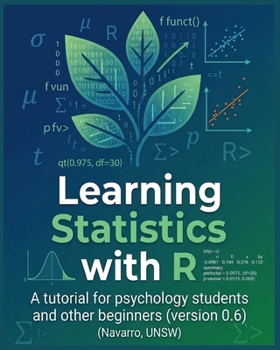
Learning Statistics with R: A tutorial for psychology students and other beginners

The book was specifically created to bridge the gap between traditional introductory statistics and modern computational tools, making statistical analysis accessible to students and researchers without a formal computer science background.
Book Overview & Core Philosophy:Unlike standard math-heavy textbooks that focus purely on manual calculations, Learning Statistics with R takes a hands-on, computational approach. It teaches statistical theory alongside practical data manipulation in R, allowing readers to analyze real datasets right from the start.
Key elements of its approach include:
Conversational & Accessible Tone: Written in an engaging, humorous, and approachable style, avoiding unnecessary jargon to reduce "statistics anxiety."
Dual Focus (Theory + Code): Explains why a statistical test works conceptually, then immediately demonstrates how to execute it in R.
Psychology & Social Science Context: Uses relatable examples and datasets drawn from psychology, human behavior, and everyday research scenarios.
Structure & Main Topics:The textbook is logically organized into progressive modules:
Section / TopicFocus Areas1. Getting Started with R: R/RStudio installation, basic syntax, data structures (vectors, data frames), and workspace management.2. Descriptive Statistics & Data Viz: Calculating measures of central tendency/spread (mean, median, standard deviation) and creating clean graphs (histograms, scatter plots, boxplots).
3. Probability & Sampling: Probability distributions (Binomial, Normal), $z$-scores, sampling distributions, and the Central Limit Theorem.
4. Inferential Statistics: Hypothesis testing principles, $p$-values, confidence intervals, effect sizes, and Type I/II errors.
5. Statistical Tests: Hands-on application of $z$-tests, Student's and Welch's $t$-tests (independent & paired), $X 2$ tests of independence, ANOVA, and Linear Regression. Who Is This Book For?
Psychology & Social Science Students: Designed specifically for undergraduates or postgraduates taking their first quantitative research methods course.
Beginner Data Analysts: Ideal for self-learners looking to build a strong foundation in both fundamental statistics and basic R scripting.
Researchers Transitioning to R: Helpful for academics moving away from legacy point-and-click software (like SPSS) toward open-source R code.
Customer Reviews
ThriftBooks ® and the ThriftBooks ® logo are registered trademarks of Thrift Books Global, LLC
