


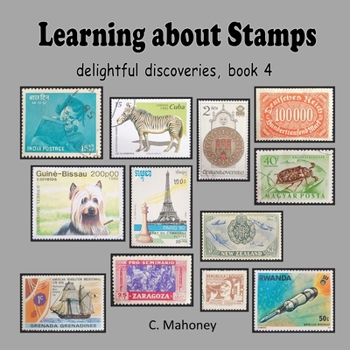
Learning about Stamps - delightful discoveries

Philately is more than just searching for rare stamps from the past or those with errors on them that weren't caught by inspectors. And it certainly isn't about putting them in a stamp album and forgetting about them. What gets me excited each day is learning about the country that issued the stamp and the subject that the stamp commemorates.
In this book, I explore stamps from as far back as 1918, stamps from islands far away and nations on the other side of the planet. I share stamps with Einstein and schooners, rockets and chess kings, chalkboards and Yorkshire Terriers, hammerheads and planets, astronauts and enchanted candlesticks, Mongolian deer and submarines, beetles and butterflies, bicycles and zebras. For each stamp, I searched online to find out its date and specifications, then used an AI agent to find more facts and details to explore. I didn't just want to be a collector of pretty things, but a researcher, an investigator, a lifelong learner. For as much of my life as I can remember, I have always been curious, wondering why people do what they do, or why something matters to other people. So, I put to work a very talented online investigator, Claude AI by Anthropic, and together we dug through the internet in search of answers to my questions.
The stamps you'll discover in this book come in shapes and colors that showcase human achievement and nature's wonders. You'll encounter words in languages spanning the globe: German and Khmer, Croatian and Romanian, Vietnamese and Hungarian, Spanish and Mongolian. Some stamps showcase humanity's creations, like sailing ships that captured British supply vessels during the American Revolution, rockets that met in space when Cold War enemies shook hands 140 miles above Earth, submarines powered by nuclear reactors, and bicycles that carried supplies through Vietnamese jungles. Others celebrate knowledge and learning, like the Silesian Planetarium teaching Poles about the cosmos, India's first Children's Day honoring the power of literacy, and young Scott Carpenter orbiting Earth three times in Aurora 7. We'll discover nature's incredible diversity through scalloped hammerhead sharks with their hammer-shaped heads detecting prey, Yorkshire Terriers descended from wolves, purple-edged copper butterflies with their evolutionary colors, and Gr vy's zebras whose stripes actually confuse biting flies. Each stamp is a window into a different corner of our remarkable world.
Sometimes I was perplexed about one of my questions. Some just didn't want to yield themselves to the demands of inquiry, but I persevered. When Claude had trouble finding a particular stamp, I dug until I found it. When I couldn't translate Cambodian or German or Hungarian, Claude jumped at the task, though sometimes I just went to Google Translate. And best of all, when I would recognize an important topic deriving from a stamp, I would task Claude with helping me research until I felt that I had learned enough to make the adventure worth having. Whether exploring why Cuba honored Einstein on a stamp (discovering his remarkable 30-hour visit to Havana in 1930), how sailing ships like the schooner Lee moved against the wind through tacking, why Germany's 1923 hyperinflation stamp showed 100,000 marks (when a loaf of bread cost 200 billion marks), or why zebras have stripes (to confuse biting flies, not to hide from lions), every chapter brought new understanding. Thirty chapters and thirty adventures, each with new understandings of the people around the world across many generations.
I hope that you enjoy my book. It is the fourth of ten as I choose to be more than a person who looks at stamps. I want to be the philatelist who investigates the people, animals, places and events that have been commemorated for all time on little postage stamps. And if you come along with me on my journey, maybe you will see just how much fun it is to learn about stamps.
Customer Reviews
ThriftBooks® and the ThriftBooks® logo are registered trademarks of Thrift Books Global, LLC
