


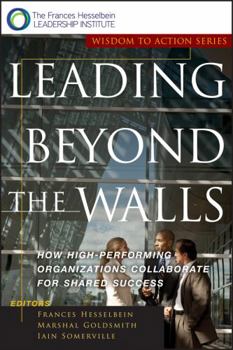
Leading Beyond the Walls: How High-Performing Organizations Collaborate for Shared Success


Select Format
Select Condition 
Book Overview
"Leading Beyond Walls" - der erste Band der Drucker Foundation 'Wisdom to Action'-Reihe - jetzt neu als Broschurausgabe! In diesem Buch diskutieren prominente Denker die neuen Herausforderungen an Führungskräfte in einem Zeitalter, in dem alte Regeln und konventionelle Grenzen ihre Gültigkeit verloren haben. Sie erforschen neue Wege für den Aufbau von Beziehungen, neue Ansätze zu Strategieentwicklung und Marketing, neue Modelle der Mitarbeiterbindung sowie eine Reihe anderer innovativer Ideen. In ihren prägnanten Aufsätzen sprechen führende Köpfe der Unternehmenswelt, wie z.B. Stephen Covey, Noel Tichy, Peter Senge, C. K. Prahalad und Peter Drucker von ganz neuen Möglichkeiten, die aber nur dann geschaffen werden können, wenn Führungskräfte bereit sind, die Hemmnisse festgefahrener Traditionen zu überwinden.
Format:Paperback
Language:English
ISBN:0787955558
ISBN13:9780787955557
Release Date:January 1
Publisher:Jossey-Bass
Length:320 Pages
Weight:1.00 lbs.
Dimensions:0.9" x 6.0" x 9.0"
Customer Reviews
5 ratings
Fresh Insight from Leading Organizational Thinkers
Published by Thriftbooks.com User , 23 years ago
I would walk barefoot to the bookstore to read something new by Peter Drucker. Now in his ninety-fourth year the man still seems preternaturally able to unearth new insights, no matter what subject commands his attention.The 23 essays in ?Leading Beyond the Walls? are based around the premise that we?ve all gotten a little too comfortable with business as usual. More to the point, that our comfort zones aren?t only comfortable, but limiting. It?s a slightly self-evident conclusion called by a new and more awkward name.Drucker gets first crack at the topic with an essay on the hazards of unfettered pluralism. Drucker is always didactic, but not in a painful way. One never feels talked down to. Instead it?s as if a wise old man has watched things develop from the vantage point of a tall tower, then comes down periodically to tell us where things really stand. His call for new community in an age of pluralism is cogent, to the point, and on the money.The remaining essays come from some name brand organizational thinkers including the likes of Jim Collins, Peter Senge and Steven R. Covey. Not surprisingly the writing and thinking are little uneven. That?s the usual price of admission for these collected works. ?Leading? was published in 1999 and there?s more than a little of the Fast Company group-think that now has been so thoroughly disavowed. ...And so reading parts of ?Leading Beyond the Walls? now is a little like déjà vu all over again. For instance, C.K. Prahalad?s breathless, dense essay ?Preparing for Leadership? reads like old Latin after Vatican II. In separate essays William Bridges and Sally Helgesen wave the ?everything?s different? banner so reminiscent of the go-go 1990s when it comes, respectively, to partners and leaders. Time will tell.By contrast, there is a wonderful timelessness to Stratford Sherman?s ?The Power of Choice,? an insightful case study on a Catholic priest in the Philippines who successfully uses choice to redeem Manila?s most hardened street children. There are no bombs thrown in ?Leading.? But one of the more incendiary essays comes from consultant Charles Roussel, who suggests that corporate governance is paternalistic and determinalistic. Roussel wouldn?t abolish boards and executive teams just yet. But he finds them largely unprepared to change or lead change, especially when it comes to modern alliances. Instead, new decision routines should be established and governance decisions driven by ?decision expeditors,? ?alliance champions,? and frontline employees. There?s a lot of meat here and my pages of ?Decision Making Beyond the Boundaries? were well marked by the time I finished reading it. Roussel?s conclusions may be right on, but I?m still digesting his rather challenging recommendations.
Leadership in the twenty-first century.
Published by Thriftbooks.com User , 25 years ago
An excellent study from the Drucker Foundation. As written by F. Hesselbein, M. Goldsmith, and I. Somerville, "Leading Beyond the Walls focuses on the first requirement of leadership in the twenty-first century. In the chapters, leaders at all levels will find inspiration and practical advice on building effective organizations that focus on their strengths and employ the resources of individuals, organizations, and communities beyond their walls. This book explores what is needed to transcend the personal walls that inhibit effectiveness and the organizational, social, and political boundaries that inhibit reaching out. It will help all leaders to achieve personal excellence and high performance and to lead beyond the old boundaries to forge partnerships that are essential in the increasingly challenging period ahead. Leading ourselves and our organizations beyond the walls is the first requirement for success in the years to come. It's a call for engagement; one each of us must answer" (from the Preface).In this context, for instance:* Jim Collins displays four important points to executives in order to be effective in the next century (pp.19-28):- First, executives must define the inside and the outside of the organization by reference to core values and purpose, not by traditional boundaries.- Second, executives must build mechanisms of connection and commitment rooted in freedom of choice, rather than relying on systems of coercion and control.- Third, executives must accept the fact that the exercise of true leadership is inversely proportional to the exercise of power.- Fourth, executives must embrace the reality that traditional walls are dissolving and that this trend will accelerate. * C. K. Prahalad argues that "In the new millennium, managers are likely to live and work in a new competitive environment characterized by the coexistence of intense global competition and increased global opportunities". Hence, he outlines some of the personal traits of leaders in the new millennium (pp.29-36).* Charles Roussel explains how some leading companies are expanding and deepening governance to cope with the demands of the networked global enterprise by comparing new and old governance (pp.57-69)* Stephen R. Covey identifies principles you need to be an effective leader beyond the walls (pp.149-158).* Marshall Goldsmith and Cathy Walt, in addition to communicating vision, demonstrating integrity, focusing on results, and ensuring customer satisfaction, describe emerging competencies for tomorrow's global leaders such as thinking globally, appreciating cultural diversity, demonstrating technological savvy, building partnership, and sharing leadership (pp.159-166).* Rita Harmon and Mel Toomey define five specific characteristics, or abilities, needed by leaders beyond the walls:- the ability to design powerful relationships.- the ability to create systemic change.- the ability to distinguish and work with pr
Leadership within or "in & out" of a cocoon?
Published by Thriftbooks.com User , 25 years ago
When cocoon becomes rigid walls, it provides seemingly secure, safe and comfortable environment. But imagine we are enclosed in home walls, no interaction with neighbors or outside world... the walls are the cells of a prison! .In this world of complexity, we continue to build rigid walls around us. In organization, we hide ourselves in silo, in departments. In society, we peddle around the designated sector: industry, interest group. In the supposedly global village, we narrowly focus on territories of national boundaries ... in the meantime, an underlying force is erupting to connect and interact with everything in space and time. A force that can have consequences beyond our imagination, as we are truly living in a world of highly interconnected and interdependent. There will be negative consequences to the extend of the peril of mankind if we leave it to chance and random happening. But a bright new world if there is emergent leadership beyond the walls. Where are these leaders?.Read on the thoughts of a panel of prominent thinkers on this subject.
A "Must Have" Book For Every Business Leader
Published by Thriftbooks.com User , 26 years ago
As a management consultant who is interested in helping executives get results I am always looking for reference material for my clients. This book clearly articulates the need (and "means-by-which") Leaders must adopt a systems perspective and then go beyond "thinking about it" to the "doing of it". It is jamb-packed with useful information and applicable ideas that will help Leaders truly "Lead", well into the new mellinium. Represented are methods you can use "right now". I will be buying this book for my clients and insisting they read it!
Wow! Insight for leading with partnerships, alliances, etc.
Published by Thriftbooks.com User , 26 years ago
This collection covers critical issues with wise insight. "Leading Beyond the Walls" is the only way that small, competitive (and it seems large and successful) organizations will prevail in the world tomorrow. We each need to focus on OUR strengths and then coordinate, partner, and work with others on THEIR strengths.The Drucker Foundation uses its expertise on nonprofit management to bring a focus on collaborative work. The examples are from across the sectors, and business is as much the subject as community-building is. I like the Reader's Guide the Foundation gives away on its site. See drucker.org for it and a sample chapter.
Copyright © 2026 Thriftbooks.com Terms of Use
| Privacy Policy | Do Not
Sell/Share My Personal Information | Cookie Policy | Cookie Preferences | Accessibility Statement
ThriftBooks® and the ThriftBooks® logo are registered trademarks of Thrift Books Global, LLC
ThriftBooks® and the ThriftBooks® logo are registered trademarks of Thrift Books Global, LLC
