


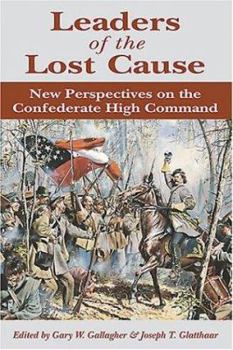
Leaders of the Lost Cause: New Perspectives on the Confederate High Command

Select Format
Select Condition 
Book Overview
This exciting and groundbreaking collection of essays looks at the lives and command decisions of eight Confederates who held the rank of full general and at the impact they had on the conduct, and... This description may be from another edition of this product.
Format:Hardcover
Language:English
ISBN:0811700879
ISBN13:9780811700870
Release Date:October 2004
Publisher:Stackpole Books
Length:294 Pages
Weight:1.16 lbs.
Dimensions:9.1" x 1.1" x 6.1"
Customer Reviews
4 ratings
Excellent Critique of the Leaders of the Southern Command
Published by Thriftbooks.com User , 19 years ago
Excellent analysis of not the best generals of the Civil War, outside of General Lee, but the early leaders of the armies in the field. Lee is oddly out of place in this collection as Braxton Bragg, Beareguard, Joeseph E. Johnson, Hood and Smith seem to have such negative images compared to Lee. Albert Sidney Johnson's early death at Shiloh allows him to stand apart as his intial success at Shiloh to a degree limits a longterm look. The most interesting essays, as one familar with the Civil War's generals would gather, are on Bragg, Beareguard and Johnson. Robertson writes a fascinating bio on Bragg who is the most puzzling general in the Confederacy. A gifted organizer but he lacked the ability to be a leader and inspire his men and generals. Bragg had an often nasty disposition and was often argumentive, allegedly even with himself when in dual roles. But Robertson points out that Bragg was, outside of R. E. Lee, the most offensive minded general of a major Army in the Confederacy. Beaureguard is pictured as having grand battle designs but also suffering from an inflated ego and like Joe Johnson, a total inability to get along with Davis. Johnson is looked upon rather severly by author Krick who notes Johnson's life long preoccupation with rank existed in the old army long before he festered over it as a Confederate General. Krick well details Johnson's passion for retreat and no plan that does extend the joke that his eastern line in the sand would have eventually been the Mississippi had he not been wounded at Seven Pines. These eassys on these three are rather negative (Krick gives a broad hint with his title on Johnson, "Snarl, Sneer and Quarrel" )though Beareguard gets high marks for saving Petersburg in 1864. Hood is also quite interesting as his career is meteor like in spite of his woundings and his intrigues in the western army help promote him to commanding general. He suffers from his weakened physical condition and the peter principal demonstrated by frequent attacks around Atlanta to destroying his army at Franklin. Smith and Cooper are less intersting but important. Smith because he becomes the Trans Mississippi commander after serving an odd satelite command in Kentucky co-existing with Bragg. Cooper is necessary as he was the senior ranking General in the Confederacy and William Davis tells the who and the why very well. William Davis is right when he called Cooper a great Civil War trivia question. The only negative, is that the majority of these characters have such major flaws described by the authors that you have to wonder how they reached such high command, but maybe the answer is simple, Davis picked them. Or perhaps, the authors are a little too critical. But these are all great essays by legendary Civil War historians James I. Robertson, Jr., Wlliam C. Davis, Robert Krick along with Gary Gallagher, Charles Roland, Stephen Engle, Joseph Glatthaar and Keith Bohannon. With historians like these, it's a full house.
A Confederacy of Some Dunces
Published by Thriftbooks.com User , 19 years ago
"Leaders of the Lost Cause" offers interesting biographical sketches of the eight men who became full general officers in the CSA. This book seems designed for the casual reader who may be suprised that the likes of Stonewall Jackson and James Longstreet are not included. Nonetheless, both serious students of the war and casual ones will profit from the book. The essays are generally of the highest quality. Gary Gallagher offers an excellent concise biography on Robert E. Lee and attempts to explain why he could remain popular in the army and with civilians despite high casualites. Charles Roland provides a solid look at the enigmatic P.G.T Beauregard and finds that the Creole general's character often undermined his leadership. William Davis offers a readable essay on the obscure Samuel Cooper and one is left with the conclusion that Cooper was the Confederate Halleck, a somewhat disagreeable, though competent, paper pusher. Stephen Engle concludes that Albert Sidney Johnson, who entered the war with high hopes and simply could not live up to them (and didn't based on his handling of the West), by dying at Shiloh, saw his reputation restored as one of the great "what ifs" of the war. Robert Krick takes Joe Johnston to task in his essay and one is forced to agree that Johnston undermined his reputation by his own comments and the book he wrote. Joseph Glatthaar agrees with Robert Kerby, the magistarial historian of the Confederate Trans-Mississippi South, that Edmund Kirby Smith was a competent young officer who was handed a task that nobody could have done in leading that isolated region during the second half of the war. At the same time, Glatthaar crushes the idea that Tom Connelly expressed of Kirby Smith having a messianic complex. The essay would have been a bit stronger if it went into Kirby Smith's rivalry with Richard Taylor and how he was able to juggle friendships with Jeff Davis and his archrival Joe Johnston. Keith Bohannon adds to the conventional wisdom that John Bell Hood, while a solid divisional commander and an agressive leader, had no business leading an army. James Robertson contributes perhaps the best essay in the collection, a look at Braxton Bragg. Robertson maintains that no "better organizer and disciplinarian exsisted in the Confederate armies" than Bragg (p. 72) and reminds readers that, with the exception of Lee, he was also the most agressive army commander. At the same time, Robertson does not overlook Bragg's many flaws as a man and as a commander. This is an interesting essay; it does not descend into the hagiographic praise for the subject that seems to plague Civil War biographers. At the same time, Robertson is challenging a great deal of conventional wisdom by showing Bragg as a better leader than most historians believe. That does not mean that Robertson has a positive view of his subject but he does indicate that Bragg had more talent than is commonly believed. One is forced to ponder his point, even
Leaders of the Lost Cause: Succinct and On Target essays on Confederate High Command!
Published by Thriftbooks.com User , 19 years ago
Gary Gallagher and Joseph T. Glaathaar are two of our most eminent Civil War scholars! In this new volume they have asked several Civil War scholars to write brief essays on the eight men who were full generals of the Confederate States of America. All of the articles are of high quality:. 1 P.G.T. Beauregard by Charles Roland. The doughty Creole was the hero of Ft. Sumter and served well during the siege of Petersburg. His service during First Bull Run was exemplary. He was not up to the top notch of battlefield leadership, coming up with some chimerical strategic ideas during the last months of the war. His service was good not great. 2. Braxton Bragg by the eminent Jackson biographer Bud Robertson shows this grouchy and inept commander at his worst. 3. Samuel Cooper is little known today but William C. Davis gives him a passing grade as the administrative leader of the Confederate government. Cooper was born in 1798, was northern born and never held a field command for the South. 4. Albert Sidney Johnson is dubbed the Hamlet of the South by Stephen D. Engle. Johnston died at Shiloh. He was a close friend of Jefferson Davis. What might have been had he lived to fight further battles is pure conjecture. 5. Snarl, Sneer and Quarrel is the opinion of Robert K. Krick the acerbic writer of the article on Joseph E. Johnston. Johnston's Fabian tactics of retreat in the Georgia campaign was a failed stategy. Krick is a great historian and his article is worth the price of the book! 6. It was the dubious duty of Edmund Kirby Smith the Florida native to defend the Trans Missssippi region during the war. He was a good subordinate but was in way over his head at such a difficult assignmentaccording to Joseph T. Glatthaar whose article is well done. 7. Keith S. Bohannon's picture of John Bell Hood is a man of all brawn and dash but little in the brain department! He was promoted beyond his abilities as he led grey legions in the Atlanta and Tennessee campaigns of 1864. 8. Robert Edward Lee was a great geneal who led the Confederate armies with bloody tenacity. Gary Gallagher is one of my favorite Civil War authors and his portrait of Lee is limned with excellent scholarship and judicious appraisal. This is a good book to whet the appetite of readers eager to learn more about Civil War leadership. As an old Civil War buff I learned some new angles to these commanders. The book is well recommended for someone just getting their feet wet in the vast ocean of Civil War scholarship. Excellent!
8 Generals Who Lead the Armies of the South
Published by Thriftbooks.com User , 21 years ago
President Jefferson Davis once wrote his brother that great generals only come around once in every generation. Unfortunately, Davis explained, the Confederacy needed a half a dozen." During the war the South had eight full generals. Of these only Lee proved to be fully up to the demands of the job. Albert Sidney Johnston died (Shiloh) before he could really prove himself. The others Joe Johnson, P. G. T. Beauregard, Braxton Bragg, Samuel Cooper, Edmund Kirby Smith, John Bell Hood did not live up to the expectations of Davis. Many of these men have not received the attention due them while other generals of lessor rank have received much more. Samuel Cooper, in particular is little known. As the adjutant and inspector general of the Confederacy, he spent the war behind a desk. But it was from this desk that the men, weapons, food and other supplies went to the front line armies. This is an excellent book, covering an aspect of the war not seen before.
Copyright © 2026 Thriftbooks.com Terms of Use
| Privacy Policy | Do Not
Sell/Share My Personal Information | Cookie Policy | Cookie Preferences | Accessibility Statement
ThriftBooks® and the ThriftBooks® logo are registered trademarks of Thrift Books Global, LLC
ThriftBooks® and the ThriftBooks® logo are registered trademarks of Thrift Books Global, LLC
