


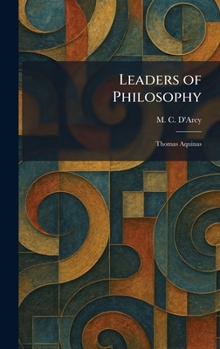
Leaders of Philosophy: Thomas Aquinas

"Leaders of Philosophy: Thomas Aquinas" provides a profound and accessible examination of the life, thought, and enduring influence of one of the most significant figures in Western intellectual history. Written by the esteemed philosopher and theologian M.C. D'Arcy, this work explores the sophisticated synthesis of Aristotelian logic and Christian doctrine that defines the system of Thomism.
The book meticulously traces the development of Aquinas's philosophical system, delving into his perspectives on metaphysics, ethics, and the nature of the soul. D'Arcy highlights the pivotal role Aquinas played in the medieval university system and his monumental contribution to Scholasticism. Readers will find insightful discussions on the relationship between faith and reason, the concept of natural law, and the classic arguments for the existence of God.
As part of the "Leaders of Philosophy" series, this volume serves as an essential guide for students and scholars alike. It illuminates the clarity and depth of the philosophical foundations found in works like the "Summa Theologica" and "Summa contra Gentiles," demonstrating why his logic remains a cornerstone of Catholic theology and a vital subject of contemporary inquiry. This study captures the brilliance of a thinker whose work helped bridge the gap between classical antiquity and the modern era.
This work has been selected by scholars as being culturally important, and is part of the knowledge base of civilization as we know it. This work was reproduced from the original artifact, and remains as true to the original work as possible. Therefore, you may see the original copyright references, library stamps (as most of these works have been housed in our most important libraries around the world), and other notations in the work.
This work is in the public domain in the United States of America, and possibly other nations. Within the United States, you may freely copy and distribute this work, as no entity (individual or corporate) has a copyright on the body of the work.
As a reproduction of a historical artifact, this work may contain missing or blurred pages, poor pictures, errant marks, etc. Scholars believe, and we concur, that this work is important enough to be preserved, reproduced, and made generally available to the public. We appreciate your support of the preservation process, and thank you for being an important part of keeping this knowledge alive and relevant.
Customer Reviews
ThriftBooks ® and the ThriftBooks ® logo are registered trademarks of Thrift Books Global, LLC
